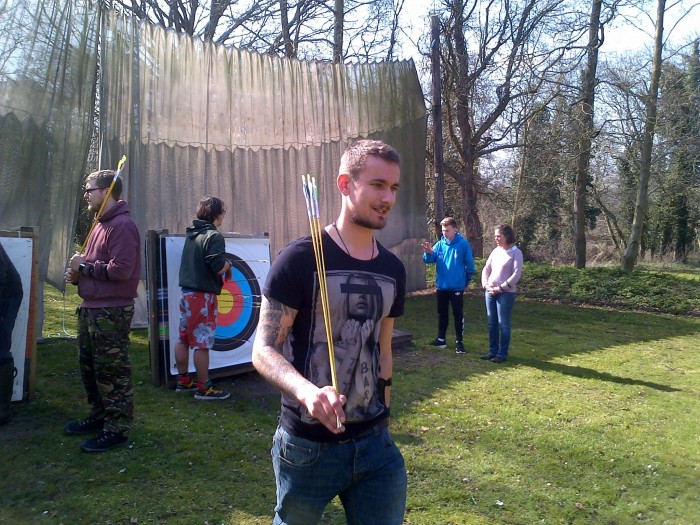
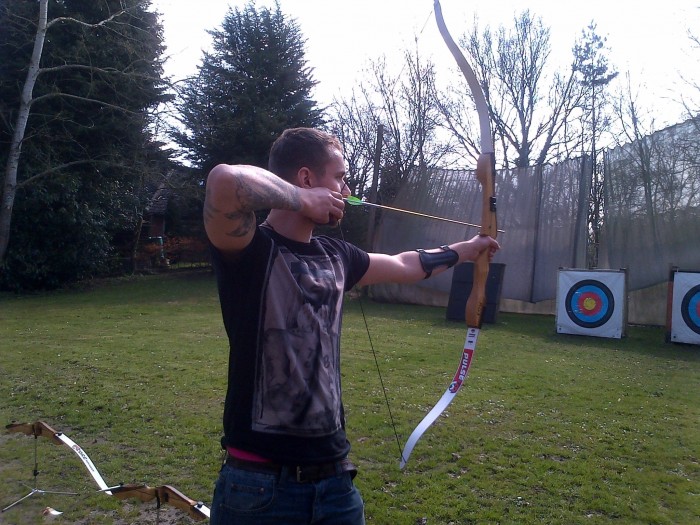
Our very own James carrying arrows back from the target.
Given that this summer is a turning out to be a wonderful season for sport, such as the Archery World Cup in Odense later this year, we decided to take a closer look at how you can join your sporting heroes and become a competitive archer……
Types Of Competitive Archery – Target Archery
First of all, it’s important to note that there are several different types of competitive archery. There’s World Archery Federation rules, formerly known as Federation Internationale de Tir a l’Arc or FITA style archery. WA rules are covered by ArcheryGB in the UK. This is what is used in major international tournaments like the Commonwealth Games, and it comes under the bracket of modern ‘Target Archery’.
This type of archery is relatively new in the lineage of this historic sport, and comes in different forms. WA archery can take place in indoor competitive spares or outdoors, with the former taking place over distances of 18 to 25 metres. Outdoor competitions vary in distance from 30 through to 90 metres. Two types of bows are typically used, either recurve or compound bows.
The competition is divided up into what are known as ‘ends’, sets of arrows which are fired in groups of 3 to 6, and within a fixed amount of time. The targets they are aiming for are made up of 10 circles arranged inside one another, and valued from one through to ten. The central ring is also known as the X ring, and is valued at 10.
The base for archery targets is made up of cloth stuffed bags or foam. They vary in diameter, from 40 centimeters, which is used in 18 metres indoor competitions, to 122 centimeters, which is used in 70 to 90 meters WA competitions, such as the Commonwealth games and other major sporting events.
Field Archery
This form of competitive archery harks back to older versions of the sport, and as such, takes place outside, often in territory which is unmarked, over a variety of distances. The major body governing this sport is NFAS (National Field Archery Society) in the UK, and NFAA in the USA.
NFAS operate their competitions typically in woodland, over distances which are unknown, and aimed at 3d targets and paper animal targets. They use 10 types of bow, including longbow, crossbow, compound limited and barebow, and cover adult, junior and under 12s, holding events up and down the UK.
Clout Archery
This runs along GNAS (Grand National Archery Society a.k.a ArcheryGB) rules in the United Kingdom. It’s similar to traditional target archery.
The basic idea is to drop arrows over a long distance into a series of circles, arranged inside one another, around a flag which marks the centre. The Clout in the name consists of the 36 arrows which
A recurve bow, with sights, in action
are fired in a group, as part of the competition.
Getting Involved
Unsurprisingly, the best way to get involved with competitions is via the relevant UK body. ArcheryGB has 45,000 members and represents 1,300 clubs. It is the national governing body for the sport from grass roots to elite competition level, and runs a variety of courses from beginners to coaching and advanced level. To get started, you can use their Club Finder. These provide a good starting point for both recreational and competitive archery. There is support for disabled archers.
Meanwhile, NFAS focuses on promoting traditional field archery as a sport, from shooting events, all the way up to coach training and competitions. As with ArcheryGB, you can apply to be a member on their website.
Grab Your Gear
Archery equipment can be hired from a variety of sources if you just want a taste – clubs can often help with this. Those who wish to commit to the sport will find affordable entry level equipment for around £100 to £300, with second hand equipment also available from a variety of sources (it’s best to have this checked by a professional before purchasing). You can contact our staff via telephone or email for advice on what archery supplies to get.
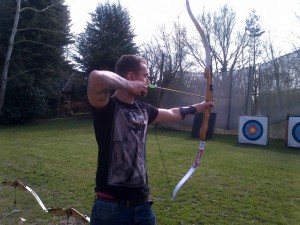
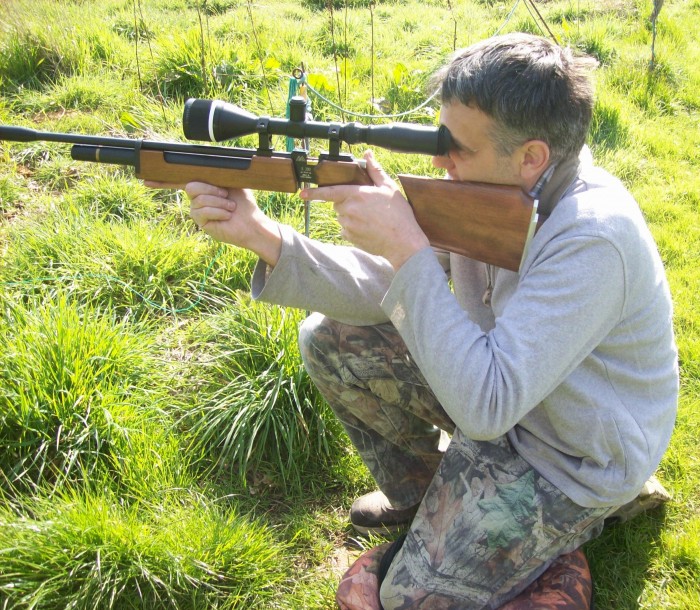
James from the Pellpax team takes aim
Stay Informed
In order to become the best, you’ll need to keep up to date with the biggest names and the best writing on archery. We regularly publish archery content here at Pellpax on our blog, and you can also head to the ArcheryGB website, which is regularly updated with news about the sport. They also produce Archery UK, their own magazine. Then there’s Archery360, which produces great content, and Bow International, another fantastic resource for archers.
Events
For a calendar of the big sporting events this year, including the World Archery Cup, which takes place in Odense in September, check out this guide provided by the World Archery Federation. Big events also take place in Dublin, Marrakesh, Bangkok, Shanghai and Las Vegas in 2016, too.
This summer will see many new enthusiasts for the sport of archery, so if you’ve discovered a newfound passion for this activity, then read on to find out how you can get involved….
All forms of archery in the UK are under governance of ArcheryGB, which is affiliated to the World Archery Federation – formerly FITA (Fédération Internationale de Tir à l’Arc) – and is a member of the British Olympic Association. The very first archery society was founded in 1537, under the direction of Henry VIII, and by the 1600s, archery was established as a competitive sport.
Archery GB
ContactingArchery GB(http://www.archerygb.org)is a good first step to learning archery. The website provides information about clubs, competitions, and courses. You don’t have to be a member of Archery GB to take part in the sport, but there are advantages. As a member, you are eligible to enter its regional and national tournaments and to attend its training courses (although not all of the courses are exclusive to members). There is also subscription to a quarterly magazine, Archery UK.
Field Archery
Field archery involves an exciting trek through woodland and open countryside, shooting at a series of archery targets from designated positions. These targets can be flat or three dimensional, upright or tilted, small or large, and at short or long distances. The archer might be shooting among trees, on a slope, across a pond, or from a gulley – you could be shooting from rocky or muddy terrain, in rain or wind, bright sunlight or semi-darkness.
Outdoor Target Archery
This is the most popular discipline in the UK. Archers shoot at circular, colour-coded targets – each colour representing two scores. The white (outer) ring is one and two, the black, three and four, the blue, five and six, the red, seven and eight, and the gold (centre) ring is nine and ten; the bullseye (10) is 2cm in diameter. Outdoor archery targets are at distances ranging from 40 yards (37m) to
A bow and arrow
100 yards (91m) for seniors, and from ten yards (9m) to 80 yards (73m) for juniors. In a competition, each archer will shoot ten ends of six arrows, thereby shooting 60 arrows in all. The maximum score for an end is 60 points.
Indoor Target Archery
Indoor target archeryis popular during the winter months. Archers shoot at a standard ten-ring target at a distance of 20 yards (18m). Like outdoor archery, both recurve and compound bows are used for the indoor sport.
Flight Archery
Flight Archery – a rare sport in the UK – is about shooting your arrows as far as you can. The obvious problem with this sport is that there are so few places it can be played. A target is, by definition, a stop for a potentially lethal projectile. It’s a challenge to find a suitable venue for flight archery!
Archery in Schools
Archery GB is working in conjunction with School Games to introduce schoolchildren to archery, offering opportunities for intra- and inter-school competition. For dedicated youngsters, there is even the chance of competing on a national level. “We believe that by supporting schools and their networks to deliver the School Games, more young people will also be introduced to archery and enjoy further opportunities through clubs.” Archery GB.
Archery GB Courses
When you join an archery club as a novice, you will likely be required to take part in a beginners’ course consisting of four to six introductory lessons, delivered by a qualified coach. The club’s Archery GB insurance covers new members for the first six lessons that they receive at the club, but after that, if you choose to continue with archery, you will need to join the club or Archery GB. Many people, of course, join both.
The Archery GB Instructor Award is designed for people working in educational environments, and for those who work in recreation and leisure. This basic, entry-level course focusses on training both experienced and novice archers to deliver safe and enjoyable introductory archery sessions.
Level 1 Award in Coaching Archery trains an archer to deliver a course for beginners and includes 12 hours’ supported practice (coaching at your own club, for example) and an assessment delivered over a 12-week period.
Level 2 Award in Coaching Archery is for Archery GB Level 1 coaches. This course teaches participants to deliver a club coaching programme, take responsibility for beginners’ courses, prepare archers for their first competitions, and to manage, mentor and support Level 1 coaches.
Archery Equipment
The oldest form of bow is the longbow, and it is still a favourite of many archers today. From about 3500 BC, the longbow was established as the Egyptians’ primary weapon of war. In the 13th and 14th centuries, longbow-men were the core of the English Army, but during the 16th century, the invention of firearms meant the decline of the bow and arrow as a war weapon.
The recurve bow is the most popular kind of bow, and the only form to be used in most world archery competitions. It’s essentially a bow with limbs that curve away from the archer when unstrung. It was invented by the Assyrians in about 1800 BC – the early models being made of wood, horn, and leather. Shorter than a longbow, the recurve bow proved to be a handy weapon to use whilst racing around in chariots. At Pellpax, we have a wide range of recurve bows and accessories in our archery shop.
Another popular type of the bow is the compound bow, which was first developed by an American, Holless Wilbur Allen, in 1966. Working on a pulley / cam system, the bow provides a mechanical advantage to the archer, allowing the limbs of the bow to be more rigid and therefore more energy efficient than those of the longbow or recurve bow. At Pellpax, we have a wide range of compound bowsand accessories.
Meanwhile, the crossbow – a short bow mounted on a stock – originated in China during the sixth century BC. The projectiles are called bolts (or quarrels), fired from a string which is released by a trigger. The crossbow is a silent, powerful, and accurate hunting tool (outside of the UK), as well as a popular discipline within competitive archery. At Pellpax, we have a wide range of crossbows for sale and accessories, which you can check out here.
Head to the ArcheryGB website to learn more about archery. Or check out our extensive range of crossbows for sale, archery accessories and other goods in our archery shop.
Airguns are a low cost form of shooting, and great fun for all, thanks to the instant feedback from hitting a target. However, they do come in all shapes and sizes, and can be something of a minefield for the new shooter, so we’ve put together this blog post to guide you through the pitfalls!
We here at Pellpax strive to be one of the best air rifle shops in the UK, and provide all the essential equipment that you require to start shooting. Furthermore, with our UK airgun delivery service we can deliver airguns and accessories to your door!
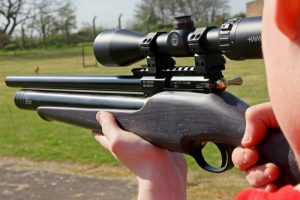
The first thing that you’ll need is an airgun. This is the catch-all term for air rifles, or air pistols, and these come in different power types and calibres. For newbies, I’d recommend an air rifle, as they are more accurate than pistols, and easier to shoot accurately, as they have a longer barrel, and benefit from a stock to hold them steady. Once you’ve mastered the basics of shooting then you can add a pistol to the collection, but when starting out it’s very easy to be disheartened with a pistol.
For a Newbie, a spring rifle is definitely the way to go. Spring rifles require minimal maintenance and no power source such as CO2 capsules, or an air bottle. The only power source is yourself, breaking and cocking the barrel on each shot. Spring rifles have recoil when fired, but this teaches you how to shoot and hold the rifle correctly to deal with this recoil, ultimately making you a better shot!
Entry Level Scopes
When it comes to firing the rifle, you can either shoot with a scope, or open sights. Open sights are more of a challenge than a scope is, but if you’re ultimately looking at a sporting event such as 10 metre or bell target shooting, then only open sights are permitted. For anything else such as hunting, Field Target or Hunter Field Target shooting, a scope is a much better choice.
As well as a rifle and scope, then other accessories are pellets and possibly a bag to keep everything safe in. Luckily we have put together several cheap air rifle kits which include a rifle, scope, bag, and pellets to get you started and shooting, as soon it is delivered by our fleet of vans.
Price Range
Rifle kits start from around the £100 mark and increase upwards from there. For £108.99 the Stinger UL Starter Kit .177 includes the rifle which fires at around 7 ft/lbs, which is more than enough for target shooting, and includes the rifle, 4×32 scope with mounts, gun bag and a tin of pellets. A great choice for those looking for something which won’t break the bank.
If you’re looking for something a bit higher quality, and harder wearing, then we can offer the Rabbit Sniper Kit, which comes with a full power .22 rifle, a hard and durable wood stock, a 4×32 Scope with Mounts, a tin of pellets, and a gun bag. Again this is everything you need to get started, and also it benefits from a little bit more muzzle energy, meaning it can be used for pest control and hunting up to ranges of around 40 metres.
Other Markets
Other areas to consider are second hand stores such as online websites, and your local gun shop which might have a selection of second hand goods. You can quite often pick up an older rifle such as a Weihrauch or BSA which has had a fair bit of use, but these are still plenty good enough for target shooting.
Of course, you can have it refurbished and returned back to its former glory with a service. Most gunsmiths should be able to offer this but it depends on how much work is involved, and their standard charges.
The Law
Before purchasing anything, though, I would recommend making sure that you know what the law is regarding air rifles and air pistols, so check out our Airguns Laws to ensure that you’re brushed up on the latest rules.
If you’ve ever fancied getting started in the world of shooting, it’s probably easier than you first thought. Let us help you with this handy guide to starting out…
First off, you have to be over the age of 18 to purchase an air rifle or air pistol, and have valid photo ID (passport / driving licence) to prove this when you purchase from a shop. If you want to buy online, We’re one of the very few internet retailers that deliver to item to your door. Secondly, the rifle or pistol has to be below 12 ft/lbs, which is the legal limit for air weapons which don’t require a license. If you take a look in our Airguns category, then everything within there is below this limit, so they only governing factor now is your budget!
The Sport of Shooting
The sport of shooting has more benefits for it that you may think, and is by no means reserved for the upper class, as many believe it is today. Air rifles and air pistols are a low cost form of shooting, and there are many local clubs which have large memberships in the disciplines of Field Target and Hunter Field Target shooting. If you fancy joining one of these clubs, a couple of great websites to check out are www.shootingclubdirectory.com and basc.org.uk/airgunning, which have details of numerous air gun clubs across the UK that would be more than happy to accommodate new members.
Of course you don’t have to be a member of a club to shoot; you can quite as easily purchase several targets and shoot on your own land. A wide range of targets are available such as knockdowns, knock and resets, and standard paper targets. You can take a look at our full selection of shooting targets here and start building your own home range today!
A lot of air rifle users also use these weapons for pest and vermin control, such as rabbits and squirrels. They present the hardest of targets as they are prone to rapid movement, and shot placement must be spot on to ensure a humane kill.
All these targets and practicing target acquisition massively improves your hand eye coordination, steadiness and sense of distance which can benefit you greatly in day to day tasks.
The Law
The law is very clear on Airguns; they are classed as a firearm and hence carry heavy penalties for misuse. For this reason you must ensure that you comply at all times, which means you must first know the law.
The Law is split down into different age groups as follows…
If you’re over the age of 18 then there are no restrictions on you purchasing an air rifle and ammunition, but you must only use it on land which you own, or have permission to shoot on. If you do get some land to shoot on with permission, I would suggest getting it in writing, as well as a map of where you are allowed to shoot. You must also remember that whilst shooting, no projectiles must leave the boundary of the land, so know your boundaries!
If you’re between the ages of 14 and 17 years old, then you can borrow an air rifle and ammunition, and use it without supervision on private premises where you have permission to do so. At this age you can’t hire or buy an air rifle, buy ammunition, or receive one as a gift. Everything must be looked after by someone over the age of 18 such as a parent, guardian or other responsible adult. You also cannot have an air rifle in a public place unless you’re with someone over the age of 21 and have a reasonable grounds to do so, such as traveling to a shooting club.
The final age group is 14 years and younger. In this age group you can use an air rifle on private land with permission, but you must always be supervised by a person over the age of 21. You can’t buy or hire an air gun or ammunition, nor receive one as a gift, and those who do buy an airgun for use for someone below the age of 14 must be sure to exercise control over it at all times.
Air Gun Power Plants
When it comes to choosing either an air rifle or air pistol, there are a few different power sources to choose from, and each has advantages and disadvantages. This is just a quick rundown on them, but for a deeper insight, check out our blog post from our Gun Smith Jason here.
Spring power is the cheapest and easiest to use as it consists of a large spring moving a piston within a chamber to compress air in front of it to move the pellet along the barrel. These guns require very little maintenance and only need the movement of you cocking the barrel to make them ready for firing. They also don’t require any other accessories. Spring guns do have recoil though, but this can be seen as an advantage, as it teaches you how to correctly hold the gun to deal with this, henceforth improving your skills right away.
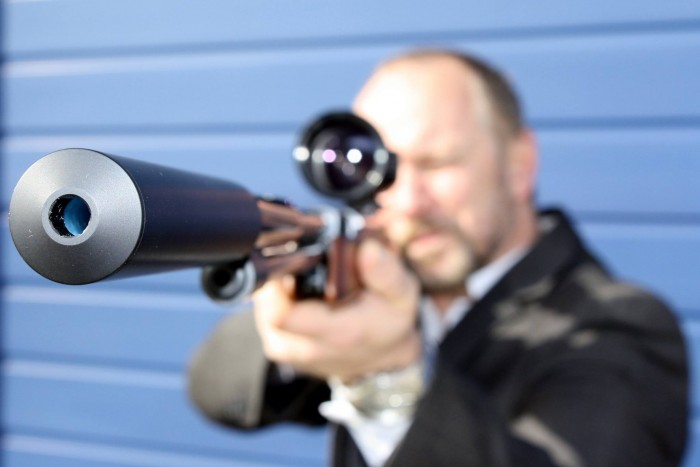
Co2 power utilises Co2 canisters which come in a couple of sizes. These are loaded into the gun, which is then released through a valve, into the barrel upon each shot. This method reduces the recoil to practically nothing, as well as cutting down on the noise from the action. This means in most cases that a silencer can be fitted to reduce the overall noise of shooting. However, Co2 does suffer from power fluctuations with the temperature, and requires you to carry spare capsules for reloading when they run out.
PCP stands for Pre Charged Pneumatic and these guns are based around an air reservoir, which is refilled with a dive bottle or stirrup pump up to pressures of 200 BAR. This high pressure air is then allowed through to the barrel through a valve. The use of high pressure air provides excellent accuracy and consistency and similar to the Co2 guns, and a silencer can be used to reduce the barrel noise. The drawback of PCP is that they are expensive to buy, particularly with the accessories, but once set up they are phenomenally accurate and simple to use which makes them the number one choice for top end competition and match purposes.
What do I need to get started?
To get started you need as little as an air gun, either a rifle or pistol, the necessary pellets, and other essential accessories such as co2 capsules, where required, of course.
Here at Pellpax we have a few kits that we have put together at a great price to get you started. One such kit is the Wildcat Kit which comes with the rifle, scope, a gun bag, a tin of pellets and a pack of our targets. Everything you need to start punching holes in paper as soon as it is delivered.
Once you have your selected item, then it’s time to start shooting! As both of these are break barrel items, you first have to tap the barrel to break it away from the breech, then grasp the barrel firmly and pull it towards you to cock it until it clicks. Then load the pellet into the barrel and return it to its starting position.
Basic Technique
Firstly, take aim at your target. with the air rifle the best technique is to not hold the stock too firmly, as you need to allow the rifle some room to recoil slightly. With a loose hold on the rifle, disengage the safety, and slowly squeeze the trigger until the shot fires.
With the pistol it is much the same, except you will need to hold it slightly tighter to support its weight, and feel free to use both hands, one round the grip and one supporting the front of the pistol to get the best accuracy. Enjoy!
From here it is really down to you developing your technique over time and fine tuning the scope / sights and practicing hitting the centre of the target and learning your gun. Of course you might consider upgrading over time to a high quality rifle, but these basic tips and kit are a great place to start.
This month, we take a look at the work of North Walsham Rifle & Pistol Club in Norfolk…..
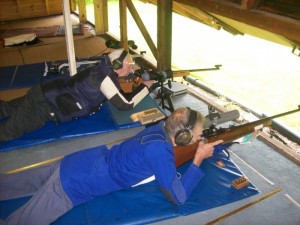
The club demonstrate shooting with rifles
Founded in 1934, with a current membership of over 200, North Walsham Rifle & Pistol Club is one of the most progressive target shooting clubs in the country. Development Officer Mike Kirkham, who has been shooting since he was 15 years old, says, “The key to our success has been to change our club culture to think more like a sports club, and to actively promote and market what we offer.”
Safety First
Taking safety precautions
The UK has the toughest gun regulations in the world – and that explains the safety of the sport in this country. Each new member joins NWRPC as a probationer. After six months (and at least 12 shooting sessions), the probationary member graduates to full membership on condition that two committee members declare that he / she is safe to shoot. The new member must then sign to say that he / she has read and understood the range rules, which are displayed on a wall in the clubhouse.
Below the range rules is the signing-in book. Every member must sign in and out on every visit. This is not only a security measure, but also a record that can be referred to in the event of a new licence application – evidence of regular shooting is an advantage to an applicant.
Ranges & Competitions
The NWRPC offers three types of shooting. The .22 target range has 10 firing points (two of which are designed for disabled users) at 25 yards, 50 metres, and 100 yards. (The discrepancy in measurement is a shooting convention.) The air range, with 12 firing points, offers sporting knock-down targets at 40 yards and 70 yards, as well as 10-metre air rifle and air pistol competition shooting. There is also a 25-yard black powder pistol gallery.
Competitive spirit is lively at this club. Some competitions (Norfolk County League, Bedfordshire League, Perthshire League, Somerset League, Hendon League, Eastern Region League) are conducted via mail; participants shoot at pre-labelled targets and send away these targets (score cards), which must be signed by an independent witness – in most cases another club member.
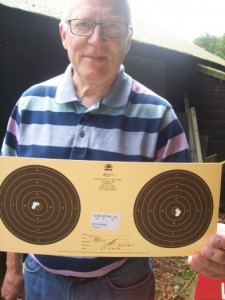
Charles Cain shows his target shooting handiwork
Charles Cain, 73 (and I must stress – a young 73), is an experienced competitor and coach. In the 1980s, he won the English Championship, and won a silver medal for England in the Commonwealth Games. The weekend before I visited the club, Charles had won the Norfolk Summer Championship in Corpusty, a competition that consisted of 80 shots: four targets at 50 yards, 10 times, and four targets at 100 yards, 10 times. Mike Kirkham came third.
Fabian Halstead (club Treasurer) told me that shooting competitions began about 100 years ago. One of the first trophies in circulation is still around today and has been won, on several occasions, by members of the North Walsham Rifle and Pistol Club. It’s a solid silver trophy, awarded to the individual with the highest score in the Norfolk Winter and Summer Outdoor County Meetings, and is housed in an enormous white cabinet – hence the affectionate nickname, ‘The Fridge’.
Funding & Future
North Walsham Gun Club receives substantial support from lottery-funded sporting bodies. Active Norfolk is the County Sports Partnership (CSP) for Norfolk, working in partnership with Norfolk’s local authorities and Sport England to increase participation in sport and physical activity. Another organisation, Sportivate, offers six to eight weeks’ free or subsidised coaching to young people between the ages of 11 and 25, with particular emphasis on individuals with a disability or from a low-income family.
The club’s key aim is to encourage youngsters in the sport. The provision of range facilities for scout groups – the main source of new members – plays an important role in the progressive development of the club. Mike Kirkham hopes that it won’t be too long before young Norfolk target shooters are competing at an international level.
The NWRPC, which is open to members from 10 a.m. to 9 p.m. 364 days in the year, had over 5,500 visits from members in the last 12 months. If you are interested in becoming a member, contact Oliver Crysell (Chairman) on 01692 581997 or head to http://www.nwrpc.co.uk for more information. To find out more about Active Norfolk head to their website.
In a recurring feature, this month Joe Meakin focuses in on the work of Staffordshire prestige gunmakers, Daystate…
Daystate are a great British success story. Alongside great manufacturers like Air Arms and BSA, they continue to produce airguns which are the envy of the world. The main focus of the company is high quality PCP (Pre Charged Pneumatic) airguns along with a range of accessories to suit. This is premium quality product, and it’s reflected in the pricing. The price range of Daystate air rifles starts from around £800 and goes up to around £2000, but you can be assured the rifles are worth every penny that you pay for them as the accuracy and attention to detail are superb.
Daystate Origins
The origins of Daystate date back to 1978 when the company was formed to produce air powered tranquilliser guns for pest control purposes which sold fairly well. The company’s big break came about in 1980 when they were approached by the well-known pest control company Rentokil, who asked them to produce a small-bore air rifle that they could use for pest control purposes in their business. This rifle was called the Huntsman, and the name is still being used on a rifle today, the Huntsman Regal. This model back in the 1980s produced 40 ft/lbs in .22 calibre which was perfect for Rentokil’s uses.
Daystate also sold a detuned, 12 ft/lbs version of the same rifle to the general public and it enjoyed a long production run thanks to its solid production and accuracy. Many airgun experts credit this rifle as the Father of all modern PCP rifles that we know today as prior to this most air rifles were powered by spring.
Shooters of course quickly realized that the PCP action had little to no recoil meaning that they were able to produce much better accuracy with these rifles. Around this time Field Target shooting was gaining in popularity and shooters quickly adopted the PCP power plant as their favoured action. The Huntsman was used by many shooters in these competitions for years, but it was one of the heaviest rifles around, but Daystate introduced a new range which included the CR94. These were dedicated to Field Target shooters, and these rifles quickly started taking the trophies at competitions which assured Daystates position in the airgun market solidly.
Modern Day Production
The MK4 (formerly known as the Panther)
Since then the company has produced numerous air rifles, both mechanical and electronic controlled air rifles such as the MK3, MK4 and, more recently, the Pulsar which are fantastically advanced air guns which maximise efficiency and consistency from each fill. Daystate have pioneered electronic controlled air rifle actions with their CDT (Capacitor Discharge Technology) and MCT (Map Compensated Technology) which are, essentially, very effective electronic actions.
The use of an electronic action means that the lock time from when you pull the trigger to the time the pellet leaves the barrel is shortened considerably. This reduces the chance of you pulling the shot off target once you have pulled the trigger, and the trigger weight is far less than is achievable on a mechanical rifle.
Daystate Pulsar
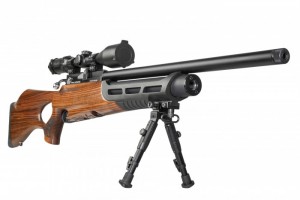
Daystate Pulsar Tactical
The rifle which features all this high tech technology today is the Daystate Pulsar which is available in a choice of stocks such as Forest Laminate and Synthetic. The electronic system has been improved from its predecessor, the MK4, in that all the electronics are encased in a waterproof case, making it truly waterproof. The electronics also operate off standard batteries, and not a special rechargeable one which previous rifles were.
The Pulsar is a Bullpup rifle which reduces the overall length whilst still retaining a full length barrel and cylinder for great performance and shot count figures in a manoeuvrable and compact package that is perfect for target shooters and hunters. A nice feature of the Pulsar, and probably my favourite, is probably, is the laser which is built-in. It activates only when the rifle is cocked and the safety is disabled, and really helps with both target acquisition, and range-finding when used with a scope.
Daystate Renegade
A new rifle that is now being released is the Daystate Renegade which is based on the same frame as the Pulsar, but it has a mechanical action, and comes in at a lower price point. This model doesn’t have a laser as the Pulsar does, and has an electronic trigger which releases the mechanical sear at the rear of the rifle, to save linkages between the trigger and the back of the rifle, which is often a failing point for most bullpups.
Huntsman Regal
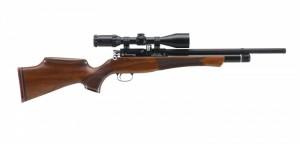
The Daystate Regal
The Huntsman Regal is their entry level rifle in their range, but is one of the finest handling, and performing rifles that I have ever used. The whole rifle is very sleek and sophisticated in the appearance, and this continues right through the whole rifle.
The unique feature of the Huntsman Regal is that the action is embedded deeper into the stock compared to other PCP rifles, which makes it feel more like a traditional hunting rifle, and balances out beautifully when brought up to the shoulder. As with all Daystate air rifles, the Huntsman Regal uses the 10 shot magazine which has been tried and tested over the years and is very simple and easy to use, and minimises any jams when loading the rifle. This is essential in a rifle, particularly when out hunting, as a jam could mean a missed shot.
Wolverine Range
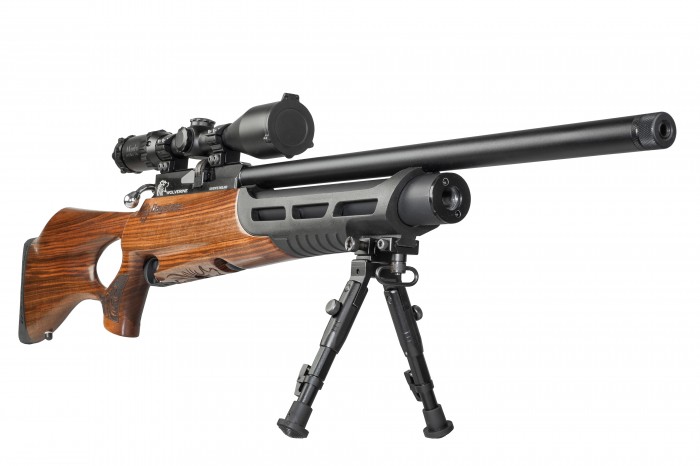
The Wolverine
The Daystate Wolverine range is in the middle of their line up, and these rifles are designed for tough hunting situations where the best is required. Daystate have made these rifles incredibly strong and hard wearing by starting off with a one piece, CNC machined breech block to which different parts such as the bolt, barrel, and cylinder and secured. This makes every aspect of the rifle which is attached to this block very sturdy which minimises any shift in zero, as well as tack driving accuracy shot after shot.
The Wolverine is available in with either a Steel 400c cylinder, or a Carbon Fibre 480cc cylinder. Both models have the same high grade Walnut stock and a shrouded barrel which makes it a delight to hold and shoot, and whisper quiet when out shooting.
All of these rifles are available in both sub 12 ft/lbs configuration, as well as FAC power levels for those who have an FAC and the allowance for one. Even in 12 ft/lbs these are great pest control and hunting rifles and are built to last from the finest of materials that are available today which you can instantly tell when you pick one up.
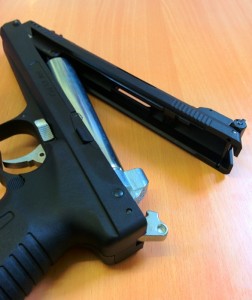
The HP-01 used to be known as the Webley Alecto but remains exactly the same pistol underneath.Both of these pistols use a pneumatic pump system where the shooter compresses air inside the cylinder which then fires the pellet when the trigger is pulled. The idea behind this design is to provide the accuracy and power of a pre-charged pistol but without the need for a compressor or air bottle, providing power and precision in the palm of your hand.
First Impressions
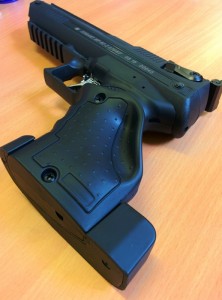
Both of these pistols actually look remarkably similar and have something about the Desert Eagle style look about them. Both are finished in matte black, with the Zoraki having marginally better detailing around the pistol grip especially. The grip of the Zoraki is also far more ergonomically shaped, for a tighter grip whilst aiming.
The HW40 is around 50mm shorter than the HP-01 which is not that noticeable, but it does weigh almost half a kilogram lighter. This was far more apparent after shooting these pistols for a good hour. I can imagine the Zoraki would start to feel heavy after a long day down the range.
Both of these pistols feel incredibly solid and utilise a high grade polymer that is moulded around a metal frame for added strength. In my opinion neither of these pistols is going to set the world alight with their looks and both of them seem to be quite generic, as they look like many other pistols in this category.
In conclusion I think the winner is the HW40 but only just, thanks its lower weight and despite its marginally inferior finish. To me, looks are not as important as something that can actually affect shooting, and the heaviness of the Zoraki started to affect the accuracy of my aim after a while.
The main difference between these two pistols is that the HW40 is a single stroke pneumatic whilst the HP-01 is a multi-stroke pistol. What this essentially means is one pump for the HW40 puts it ready to fire at full power whilst the HP-01 can be pumped between one and three times to reach any of its three power settings. Pump once for low power, twice for medium and three times for full power. This gives shooters extra flexibility in how much power they want but aside from testing I found myself using the second and third power settings exclusively.
The only reason I can think why you would use the lowest setting is that the pistol makes less noise… but who doesn’t like loud noises?! Ok, your neighbours might not, and I understand that noise is a valid concern in built up areas, but when down the range I can’t see a good reason to shoot at the lowest power setting.
Now, I’m not Jeremy Clarkson! Power isn’t everything but it does mean flatter trajectories and better range, things that are far more desirable to me than quietness. I have heard reports from people of increased muzzle rise when fired at full power, but it was not something I noticed, particularly when shooting two handed.
However, I was using an under side mounted laser on the HP-01, which may have acted as a barrel weight, reducing the muzzle rise but again, unless you are in serious target shooting competitions, I’m sure this issue is not something that will bother you.
To pump the Zoraki to full power takes quite a bit of strength, while the HW40 is slightly easier. One thing to note it is quite easy to catch clothing and fingers whilst closing both pistols so make sure you have both out of the way when shutting the breech. I’m going to give the win to the HW40 again here as it is slightly easier to pump and only requires one pump to shoot at its most powerful as opposed the HP-01.
Winner: Weihrauch HW40
Shots Fired
Despite early wins for the HW40, here is where the ZP-01 really comes into its own. When both shooting at full power the HW40 produces around 2 ft/lbs of muzzle energy, while the HP-01 produces around 5.5ft/lbs. This is a big difference and means that whilst the HW40 will struggle to go through an empty Coke can, the HP-01 is capable of taking out pets such as rats quickly and humanely and is one of the few non PCP or spring powered pistols that is capable of close range pest control.
Power to spare: The Zoraki HP-01
This really puts the Zoraki in a different class of pistol from the Weihrauch and makes it ideal for almost any shooting discipline, whether it’s target shooting, plinking or pest control. On the other hand, the Weihrauch is only really good as a short range plinker or target shooter.
It is worth noting at this point that the Zoraki is nearly £100 pounds more expensive and so a difference in quality is to be expected but if you are looking at serious competition shooting or to take out some pesky pests, there is really only one option.
The triggers of both are two stage and fully adjustable with a hex key, with the ZP-01’s match trigger being crisp and sharp and the HW40’s having a tiny bit of creep, but not enough to affect accuracy. Both group well at their effective ranges using Air Arms Field (4.51) pellets and neither pistol experienced any jams or problems while testing.
There is only one winner here; the Zoraki is so much more versatile in its use with higher power and a much longer effective range. This is where the price difference of the two pistols really becomes apparent, as the HW40 is certainly not a bad pistol, and performs better than most other pneumatics in its price range, such as the Beeman 2004E. However its lack of power is to be expected, as it almost half the price of the Zoraki.
Winner: Zoraki HP-01/ Webley Alecto
Sights & Extras
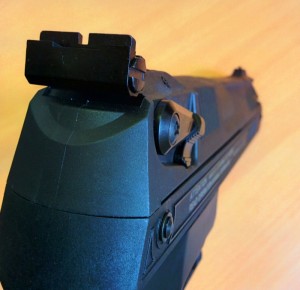
The iron sights of the Zoraki HP-01
The sights of the Zoraki are also of exceptional quality, with the foresight flipping over to offer a choice of blade width, as well as different positioning. This allows for great accuracy right out of the box. The HW40 features front and rear fibre optic sights that are fully adjustable, although not as much as the HP-01’s, and are again, perfectly aligned. The fibre optics work in all but the darkest of conditions. It is worth noting that the Zoraki’s iron sights are not fibre optic so external optics is required for shooting in low light conditions.
Both pistols feature rails on top for the easy attachment of red dot sights or scopes, but only the Zoraki has an under mounted weaver rail for laser sights, torches or other suitable attachments. I used a laser in my testing, set up to 45 yards, and although a red dot sight is more effective for target acquisition, it is nice to have the option for under mounted attachments.
In terms of accessories the HW40 is a bit of a bare bones affair with the pistol and manual included in the box, whereas the HP-01 comes with a bottle of gun oil, adjustment tools and a cleaning brush as well as the manual and gun. Another nice feature included with the Zoraki is a test sheet from the factory showing the grouping achieved with each particular pistol. It was, according to the sheet, tested using Crosman pointed pellets which are not exactly famed for their accuracy. This strikes me a bit like Audi including official 0-60 figures with their latest car in snow tires, but whatever, it’s nice to have and gives each pistol a more individual touch.
The added accessories as well as the under mounted rail means I have to give this one to the Zoraki HP-01.
Winner: Zoraki HP-01 /Webley Alecto
And The Winner Is…
Well its 2 – 2 so far in the categories but I have to pick a winner. There is no penalty shootout this time, no referendum, the answer is obvious. With its adjustable power, crisper trigger and extended range the winner has to be the Zoraki HP-01.
The HW40 is a very good pistol for its price point and provides the best accuracy of any pistol that is sub £150. If you are looking for a pistol just for plinking there is no reason not to buy the HW40 but it is just outclassed by a far more expensive and more versatile pistol. The Zoraki is an excellent target shooter, plinker, pest controller or vermin hunter with rails for a variety attachments making it one of the most powerful and versatile pneumatic pistols on the market today.
Which air pistol do you think makes the grade? Do you own either? Or have you got a different recommendation altogether? Let us know in the comments below.
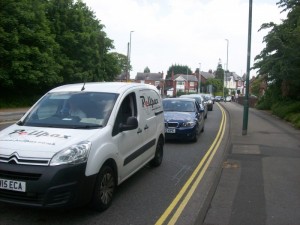
One of our distinctive Pellpax vans on the way to a delivery.
One of the most important parts of Pellpax is our door to door airgun & shotgun delivery service. Unlike many of our competitors, who often send your order to your local Registered Firearms Dealer for collection, we have the facility to deliver air rifles, air pistols and shotgun cartridges nationwide, directly to your door.
These deliveries take place each weekend thanks to our team of drivers, many of whom are previously members of the armed forces and police. To shed more light on this very special air rifle delivery service, we sent out blogger and writer Hazel Randall to spend some time with one of our drivers…..
Friday lunchtime:
Parcels are being loaded into the van in reverse order of delivery. Every item has been double-checked, all guns have been fired, and each package has the customer’s name written clearly on it. The driver, Chris Avern, is handed a folder labelled NORTH, which contains 54 invoices and three hotel booking forms, all in correct order. Taped to the front of the folder is Pellpax’s Certificate of Registration as a Firearms Dealer.
Sophisticated software used in the Pellpax office has calculated the route and approximate time between drops. Taking into account time that will be spent with customers, an estimated time of arrival has been written on each invoice, and customers have been advised of this time. (No pressure then, Chris.)
Chris programmes the satnav with the postcode for the first drop, copied from the invoice. The satnav shows an estimated time of arrival – a few minutes earlier than the time shown on the invoice.
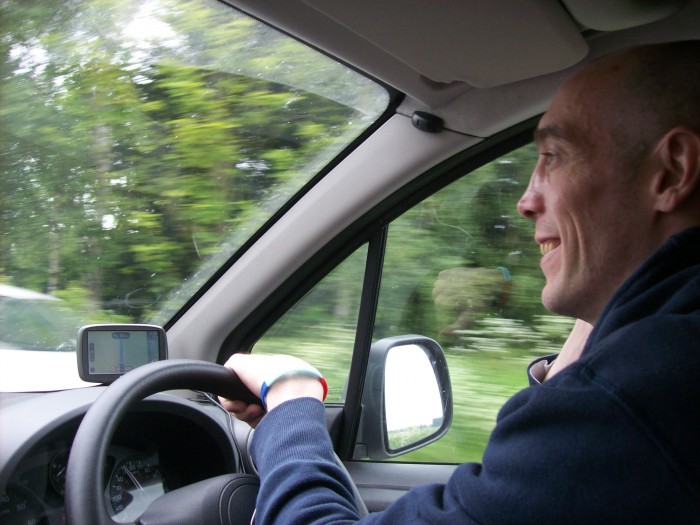
Pellpax delivery driver Chris tours the country each weekend.
Chris locks the back door of the van and sets off. In the back of the van there’s a CCTV camera, and above the passenger seat is a tiny monitor. Security is paramount.
The sky is overcast and there’s a chill in the air, but the weather forecast for the north of England is good. With Radio 2 playing in the background and mobile phone (with Bluetooth connection) fixed to the dashboard, Chris begins his solitary three-day sojourn.
This is the first weekend in June. White hawthorn is frothing madly in the hedgerows, its sweet scent drifting into the van. Now and then, a splash of pink or red may blossom grabs the eye, and then it’s gone, leaving its glorious image hovering in the memory. Meadows are studded with daisies, and in the gardens, laburnum trees are weighed down by copious yellow blossom.
Chris arrives at the first address five minutes ahead of time. He takes the customer’s package from the van and knocks on the front door. The door is opened by a smiling, middle-aged man, who congratulates Chris on his excellent time-keeping. The two men have a friendly chat, and the customer tells Chris about his pigeon problem. The client’s ID documents are on the hall table, ready for this delivery.
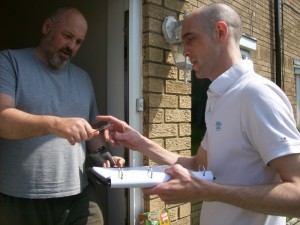
When Chris delivers a gun or any item related to guns – pellets, scope, silencer, etc. – he must see photographic ID and a household bill that connects the client’s name and billing address. Chris records passport or driving licence serial numbers, and signs to say that he has seen the documents. If the photographic ID is something other than passport or driving licence, and there is no serial number to record, Chris takes a photograph of the document for reference. Then the client signs the form. When the paperwork is complete, Chris hands over the goods and the invoice and invites the client to check his purchase.
Chris makes a successful delivery to another happy customer.
Back in the van, Chris takes the second invoice from the folder and enters the postcode in the satnav. The ETA displayed on the satnav is 10 minutes ahead of the ETA on the invoice. Chris is making good time.
Already, the sky is clearer and the sun is warming the air. Chris takes off his sweater and throws it onto the passenger seat. He winds the window down halfway and sings along to Dire Straits and Walk of Life.
In the beautiful city of Lincoln, the Pellpax van scoots up and down the steep roads, carving a route between flower-filled gardens and elegant architecture.
When the Romans invaded the Iron Age settlement of Lindo (Celtic for pool) in 48 AD, they renamed the town Lindum Colonia, but by 1066 the name had evolved into old English Lincylene. During WW1, the first ever tanks were designed and built in Lincoln, and the city’s manufacturers continued to produce a wide range of military vehicles during WW2.
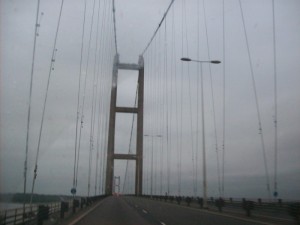
After one drop in the middle of Lincoln, Chris heads for The Humber Bridge – a 2,220-metre suspension bridge over the Humber Estuary, connecting Lincolnshire to the East Riding of Yorkshire. The Humber Bridge is the seventh longest of its kind in the world; however, when it was opened to traffic in 1981, it was the longest. It’s foggy and drizzling with rain when Chris makes the crossing. With the window wound up, he croons an accompaniment to Dolly Parton as she sings I Will Always Love You.
Crossing the Humber Bridge
In the evening, after a delicious spicy pizza and a bottle of Coke, Chris arrives at a pre-booked hotel in Bradford. He has delivered to ten addresses today. Backing the van against the car park wall, he takes his overnight bag into the hotel, signs in, and snuggles into bed.
***************
Saturday morning
Chris is jerked awake, by his phone alarm. The first drop, half an hour’s drive from the hotel, is due soon. Chris showers, dresses, and finishes up last night’s pizza. Shortly after, he’s driving away from the hotel, squinting into the low sun.
Chris arrives in good time at the first address. The customer is wearing a dressing gown but answers the door promptly, ID in hand. He and Chris greet one another like old friends. This is a repeat customer – a man appreciative of the Pellpax air rifle delivery service.
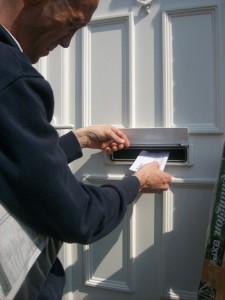
The next customer is not in. Chris knocks several times and phones the contact number given on the invoice. Five minutes after the due delivery time, Chris writes a note to say that he has called and slips it through the letterbox. He’ll have to take this item home again.
Nobody’s home, so Chris leaves a note for a customer.
Twenty minutes later, Chris is driving into the pleasant grounds of a residential home. The sniper rifle to be delivered is for a member of staff. The door is opened by the client’s colleague, who has her own ID ready. Chris asks to see the client’s ID as well, but it seems that he hasn’t left it for her. Chris has no other phone number for the client, other than the number for this address. The lady tries to contact the client, but with no success. Chris apologises and says that he will not leave the rifle without seeing the required ID. There is no other option – he must take the gun back to Pellpax.
Today’s route takes Chris over the Yorkshire Dales. But first he must fill up with diesel – and coffee. The large red Costa sign that stands at the garage entrance is reminiscent of one of those seductive ladies who stand by an oasis in the Road films, beckoning to Bob Hope and Bing Crosby. Fortunately, the Costa sign is not a mirage.
Chris has long distances to drive between drops today. There are only 16 addresses to visit, but they span a distance of several hundred miles.
The view from Sharp Haw – a hill with an elevation of 357 metres on the southern edge of the Dales – is stunning. The word ‘haw’ comes from Old English ‘hawian’ (view). Chris stops the car and gets out for a few moments. His feet brush past bright yellow buttercups on impossibly slender stems, vying for attention with gorgeous campion and achingly pretty bindweed.
There are traffic jams in Hull. Temporary lights at roadworks seem to be permanently red. Chris makes a phone call to his next customer, explaining that he’s stuck in traffic queues. Apologising for the delay, he gives an estimated time of arrival, adding that he might be even later. The customer says not to worry – she’s well aware of the roadworks and the delays they’re causing.
After dropping off the parcel, Chris phones the next customer. He’s twenty minutes behind time, but the roads are fairly clear now. He tells the customer that he’ll be there within half an hour.
It’s evening, and Chris makes his final drop of the day 15 minutes after the due delivery time. Perked up a little by a nourishing KFC, Chris makes his way to the pre-booked Travel Lodge in Hull. Before signing in, he enters the postcode of tomorrow’s first drop in the satnav. He signs in, has a shower, and falls into bed.
***************
Sunday morning:
Chris wakes, showers and leaves the hotel. His mood is not going to match the lovely weather until he’s had a coffee. After ten minutes of driving, an oasis appears. With a large Costa coffee inside him, the monster that got out of bed minutes earlier turns into a Beach Boys backing singer.
This morning, Chris delivers the only shotgun of the weekend – a Webley and Scott 900 Extreme Sporter 30” Barrel, 12 gauge. In addition to ID checks, Chris must see the client’s firearms licence and sign to say that he has seen it. With this invoice are two copies of a Firearm Transfer Notification letter. On this occasion, there are no shotgun cartridges delivered, but we do have the very rare facility to do this, also.
The client must enter information about the firearm purchased from Pellpax, including the serial number, along with his own name, address, and licence number. It’s the client’s responsibility to send his copy by recorded post to his local firearms department. Chris takes the second copy back to Pellpax for their records.
A drop on the western outskirts of Kendal takes Chris through the picturesque town, famous for Kendal mint cake, the high-energy confectionary that sustained numerous explorers on expeditions to Mount Everest, K2, and the north and south poles.
During the first half of the second millennium, the main industry in Kendal was the manufacture of woollen goods – notably the hard-wearing fabric known as Kendal Green, worn by archers in battles of the Hundred Years War. The cloth was steeped in a yellow dye produced from Genista tinctoria (dyer’s broom), and then overdyed with blue Isatis tinctoria (dyer’s woad). The motto on the Kendal coat of arms is Pannus mihi panis (cloth is my bread).
Driving over Lambrigg Fell in Cumbria, Chris passes the Lambrigg Wind Farm (pictured), owned by RWE npower renewables (previously National Wind Power). The wind farm, opened in September 2000, comprises five turbines that produce enough pollution-free electricity to meet the average needs of around 2,500 UK homes.
Today takes Chris both under and over the River Mersey, and across the rivers Kent and Aire. He crosses the Manchester Ship Canal and the Aire & Calder Navigation, which leads into the Leeds & Liverpool Canal.
Grazing the outskirts of Liverpool, Chris’ route wends eastward. The day ends at a Premier Inn in Derby – an unusual arrangement of chalet-style rooms around a courtyard, with external stairs to the upper storey. Chris drops his bag onto the floor and falls face-down onto the bed.
***************
Monday morning:
Just eight more drops to do. For some reason, Chris craves something fishy to eat. He settles for a prawn-mayonnaise sandwich from a garage shop, accompanied, of course, by a Costa coffee. This leads to a hearty rendition of the James Bond theme song, Nobody Does it Better.
After the final drop, Chris fills up with diesel; there’s a two-hour drive back to the Pellpax base in Aylsham, Norfolk. When he arrives, Chris hands the undelivered items to sales manager, Jason Whittle, explaining the circumstances of each one, and takes the paperwork to the office.
This weekend, Chris has driven over a thousand miles, through 14 counties, and has visited 54 addresses. Next weekend will be similar, but the route will be different. But now it’s time to go home. Chris exchanges the Pellpax van for his own ‘Fred’, and drives away, just in time to collect his son from school.
When it comes to airsoft blogs, a good one can be hard to find. The main things we look for in in good airsoft and air gunning blogs are attention to detail, photos and connection to the reader. These are Ross Mitchell’s top 5 airsoft blogs that offer an eye-catching and in-depth read….
Number 5: Airsoft Odyssey
Yosser’s Airsoft Odyssey
Coming in at number 5 is Airsoft Odyssey. This website has a variety of areas ranging from videos, kits and helpful blogs. The blog I read in particular was the WE Makarov Test and Review. In this blog, we see them take the iconic Makarov pistol and break it down talking about the whole process from unboxing the pistol to shooting it. A section of the blog that I found really interesting was where he put it through a Chronograph test.
Now, I won’t spoil it for you but he first tests the Makarov without the barrel extension on but once attached the results were very interesting. Overall I like this blog as he goes into great detail about the bb’s and gas he uses, tests and talks about all the little features of the gun and he’s got some pictures showing the guns iconic design!
Number 4: Airsoft International Magazine
Meanwhile, for Number 4 we have a blog aimed at beginners in the airsoft world. This blog is from http://www.ai-mag.com and is very neat and well presented. Within this medium sized blog we can see him starting off by talking about the laws on airsoft rifles. Now, the UK is known for being nervous around anything that looks like a gun, and to prevent Realistic Imitation Firearms (RIF) being misused there are licenses and regulations you have to comply with.
This is one of the reasons I found this blog a good read. They break each part down to explain firstly why the law and licenses exist, and then continue to talk about how this affects you when buying a RIF. Finally they finish by going into detail on how you can obtain one. Whether you’re new to airsoft or more experienced, I recommend this read as it goes into good detail but portrays it in a short, simple way.
Number 3: Airsoft & Milsim New Blog
Airsoft & Milsim News Blog
Number 3 in our airsoft blogs we have a gun review. Now, when it comes to blogs there is nothing I like more than a well written, detailed gun review. Not only do I find them the most interesting to read about, I like to see others opinions on certain rifles and pistols and see if they agree / disagree with my thoughts. In this review from www.airsoft-military-news.com they take the Modify XTC-G1 Carbine and provide a thorough review. The blog is fairly long but they break it down into small paragraphs to make it an easier read.
These paragraphs are put under subtitles which include: Externals; The Frontset; The Receiver; The Stock; Hop-Up/Inner Barrel; Gearbox and then is finished with a conclusion. Within this blog I like that they put pictures for nearly every paragraph so you can see the step by step process they go through. This includes sights, stock, magazines, disassembly of the rifle and more.
The amount of detail they go into for each part is why this blog is number 3 on my list. They show you every spring, wire and bearing even include the manufacturing processes they went through making this a very interesting read for both new and experienced players. If you’re not one for long reads then the conclusion is a nice extra as it has a few paragraphs which sums ups the highlights and lowlights of the rifle. It’s then finished off by having the gallery with all the pictures used in the blog.
Number 2: Black Rams Airsoft
For our airsoft blog list Number 2 is another gun review but has a big difference to number 3. This blog from http://www.blackrams.co.uk they review 3 different AEG rifles and compare them together at the same time. I like their choice of rifles as they’re similar to each other making the review more relevant but still have differences allowing them to be compared. They start off with the Bolt B4 AEG blow back.
They dive straight into the review by talking about the internal V2 gearbox. After explaining the gearbox system they move on to the recoil and sound. I really like how they compare the recoil, the sound produced by the rifle and more characteristic to inform you how realistic the rifle is which I haven’t seen in many other blogs. They then move onto the WE M4 and use a similar structure to compare it by starting off talking about the trigger and internal mechanism, then move on to recoil and realism.
Their 3rd rifle is the Tippmann M4, which is Co2 powered and gives them a bit more to talk about as they go into detail on what Co2 cartridges you can use before following the structure. The whole blog is then finished off by a summary stating what the most realistic rifle is, then the easiest to use and so on. Overall, this is a good read for anyone interested in airsoft and is very informative, without being long and drawn out.
Number 1: Femme Fatale Airsoft
Now Rated Number 1 on my list is a well-known group in the airsoft community. The blog I read was G&G Custom CM16 SRL by http://www.femmefataleairsoft.co.uk. Now this blog is interesting for many different reasons. First of all it is a gun review which I love but it’s based on a custom gun where there was only one in the world. In this blog, airsoft enthusiast and expert Kelly Hardwick expresses her love for a custom CM16 SRL known as “The Black Rose Version 2”. She starts off by talking about where she first found it and why she fell in love with it. Then one day she got a package from G&G and it was her very own one! She gives a very accurate and in depth review of the rifle ranging from its build quality to its power and fps.
She included some great pictures in the blog showing the rifles best features off and then shows her using it. From reading on in the blog she starts to compare it to the first Black Rose and explains how G&G stepped up from it. Overall I found this one of the most interesting airsoft blogs around and really like the story behind it as well as the great pictures. The main feature that kept me hooked was where she talked about her opinions on it for example she says “I have always held G&G in high regards to their quality, reliability, affordability and performance”. This blog is definitely worth a read even if you’re not a fan of G&G!
To check out our extensive and growing range of airsoft rifles and airsoft pistols by the big manufacturers like Tokyo Marui, Ares, KWC, WE and many more, head to the store.
In a new feature, we take a look at airgun clubs up and down the country. This month it’s the turn of Cromer Air Rifle Club, which is in our part of the world, Eastern England.
Cromer Air Rifle Club was established in 1974. Like most airgun clubs at that time, it was an indoor range, which meant shooting paper targets at six yards, using 6 ft/lb air rifles – not too challenging, but great fun when you’re in competition. But as the sport waned in popularity, so did local competition. Airgun clubs’ membership was diminishing, and some clubs just folded. For the handful of members remaining in the Cromer Air Rifle Club, indoor shooting was not much fun.
So, in the 1980s, the club moved outside, to a range where members could shoot at 55-yard targets, using 12 ft/lb guns. The ft/lb unit is a measurement of kinetic energy, calculated by multiplying half the mass of the projectile by the velocity squared. It is a legal requirement that an airgun that shoots over 12 ft/lbs (approximately equal to 16 joules) must have a firearms certificate.
Outdoors, with mud, foliage, nice views and weather, competition wasn’t so important. Shooting with a few friends, or even alone, was a pleasure. Now airgun shooting was fun again, and, as you would expect, club membership grew.
Nick Larty with a hand-built Sports Match GC2 air rifle
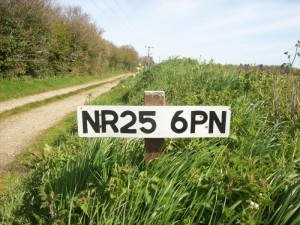
The Cromer Air Rifle Club now has its home in Bodham, in a quiet, out-of-the-way location on farmland. The long track that leads from the road to the shooting ground is very thoughtfully signposted with the location’s postcode. Shooters meet every Sunday morning between nine o’clock and twelve o’clock, unless it’s raining.
There are only eight airgun clubs in this region – a region that covers no fewer than eight counties. The winter league, which takes place every year between October and April, is open to all members of these eight BFTA (British Field Target Association) clubs, and each club takes a turn to host a round.
It’s a thirty-shot course, undertaken in pairs. In each of the 15 lanes there are four targets – two for each shooter. Every metal target is punched with a hole, which is 35 mm, 25 mm, or 15 mm in diameter. Behind the hole is a piece of metal on a spring, which, when hit, gives a satisfying ‘clunk’.
Airgun shooting is normally done in a sitting or lying position, but some of the targets in the Winter League competition are ‘positional’ shots, which must be taken from a standing and a kneeling position. (If your knees aren’t up to kneeling, you can opt for standing only!)
If you are interested in taking up airgun shooting, or if you are an experienced shooter looking for a local club, contact Nick Larty, Cromer Air Rifle Club co-ordinator, on 01263 570 223 or 07796 904 482, or just turn up at the club on a Sunday morning from 9 a.m. The postcode is NR25 6PN.

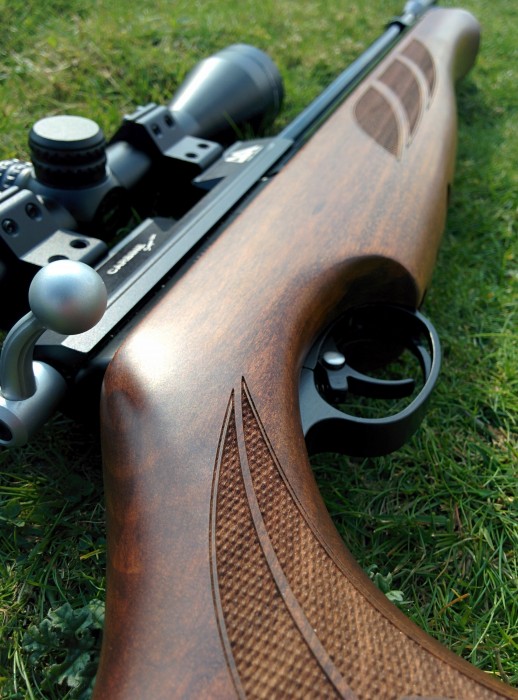
 If you’ve ever fancied getting started in the world of shooting, it’s probably easier than you first thought. Let us help you with this handy guide to starting out…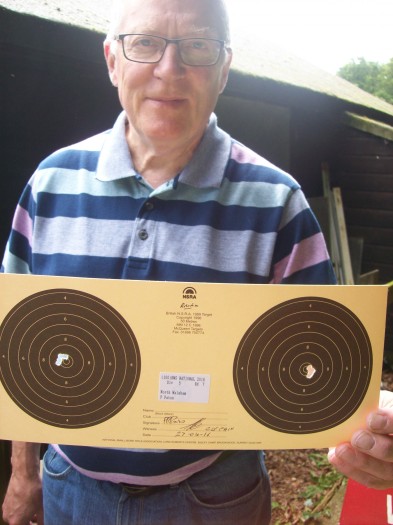
 In a recurring feature, this month Joe Meakin focuses in on the work of Staffordshire prestige gunmakers,


 Driving over Lambrigg Fell in Cumbria, Chris passes the Lambrigg Wind Farm (pictured), owned by RWE npower renewables (previously National Wind Power). The wind farm, opened in September 2000, comprises five turbines that produce enough pollution-free electricity to meet the average needs of around 2,500 UK homes.



 must be taken from a standing and a kneeling position. (If your knees aren’t up to kneeling, you can opt for standing only!)