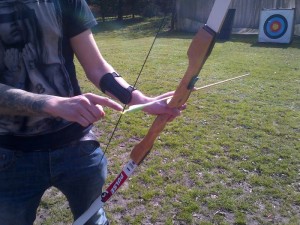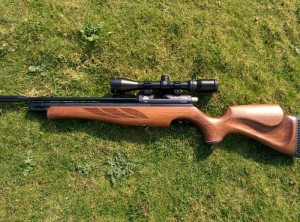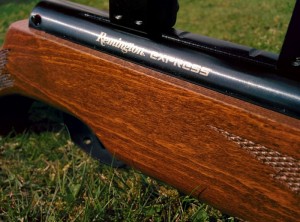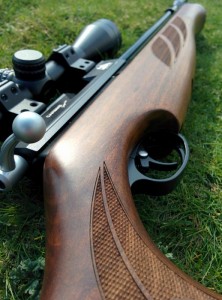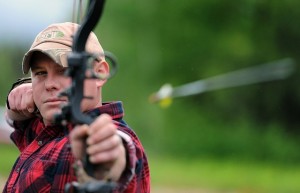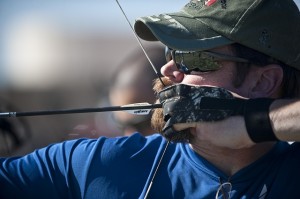
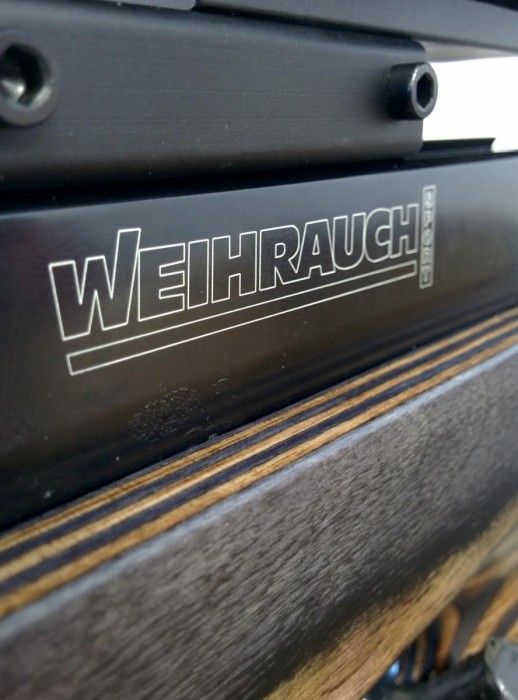
In a new feature, we take a look at airgun clubs up and down the country. This month it’s the turn of Cromer Air Rifle Club, which is in our part of the world, Eastern England.
Cromer Air Rifle Club was established in 1974. Like most airgun clubs at that time, it was an indoor range, which meant shooting paper targets at six yards, using 6 ft/lb air rifles – not too challenging, but great fun when you’re in competition. But as the sport waned in popularity, so did local competition. Airgun clubs’ membership was diminishing, and some clubs just folded. For the handful of members remaining in the Cromer Air Rifle Club, indoor shooting was not much fun.
So, in the 1980s, the club moved outside, to a range where members could shoot at 55-yard targets, using 12 ft/lb guns. The ft/lb unit is a measurement of kinetic energy, calculated by multiplying half the mass of the projectile by the velocity squared. It is a legal requirement that an airgun that shoots over 12 ft/lbs (approximately equal to 16 joules) must have a firearms certificate.
Outdoors, with mud, foliage, nice views and weather, competition wasn’t so important. Shooting with a few friends, or even alone, was a pleasure. Now airgun shooting was fun again, and, as you would expect, club membership grew.
Nick Larty with a hand-built Sports Match GC2 air rifle
The Cromer Air Rifle Club now has its home in Bodham, in a quiet, out-of-the-way location on farmland. The long track that leads from the road to the shooting ground is very thoughtfully signposted with the location’s postcode. Shooters meet every Sunday morning between nine o’clock and twelve o’clock, unless it’s raining.
There are only eight airgun clubs in this region – a region that covers no fewer than eight counties. The winter league, which takes place every year between October and April, is open to all members of these eight BFTA (British Field Target Association) clubs, and each club takes a turn to host a round.
It’s a thirty-shot course, undertaken in pairs. In each of the 15 lanes there are four targets – two for each shooter. Every metal target is punched with a hole, which is 35 mm, 25 mm, or 15 mm in diameter. Behind the hole is a piece of metal on a spring, which, when hit, gives a satisfying ‘clunk’.
Airgun shooting is normally done in a sitting or lying position, but some of the targets in the Winter League competition are ‘positional’ shots, which must be taken from a standing and a kneeling position. (If your knees aren’t up to kneeling, you can opt for standing only!)
If you are interested in taking up airgun shooting, or if you are an experienced shooter looking for a local club, contact Nick Larty, Cromer Air Rifle Club co-ordinator, on 01263 570 223 or 07796 904 482, or just turn up at the club on a Sunday morning from 9 a.m. The postcode is NR25 6PN.
In a recurring feature, this month we zoom in and take a special, closer look at German airgun manufacturers, Weihrauch.
Weihrauch is one of the oldest gun manufacturers still in business today – the start of the company dates back as far as 1899. One fun fact to note is that the business was started in a town called Zella-Mehlis, where gun makers Walther and Anschutz also began! The original founder of the business was Hermann Weihrauch Sr. who was a superb hunting rifle manufacturer, and along with his three sons they created the business, making a selection of small bore rifles, along with a range of shotguns. These models had an excellent reputation for outstanding quality, as the Weihrauch range still does to this day. Of course, Weihrauch were affected by both World Wars and were evicted from Germany post WWII as their factory fell inside the Soviet zone. From here Hermann Weihrauch Jr. (one of Hermann Weihrauch Sr.’s sons) started off the Weihrauch firearms business in the 1950’s but with the aim to produce the finest sporting airguns in the world.
Beginnings : 1950s
Several models were produced from around 1950 onwards including the HW50V, the HW25 and HW55. The HW55 quickly became one of Europe’s leading break barrel target rifles, which was a massive help to kick start the company’s reputation in the airgun market. The Weihrauch HW35 was released in 1955 and has been one of the most successful air rifles in the world, and is still in production today, which makes it the longest running model in airgun history.
HW35 Air Rifle
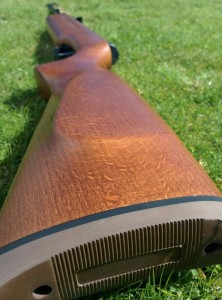
The simple, perfectly crafted lines of the Weihrauch HW35
The HW35 is a full size sporter air rifle which has a spring powered action and has been a firm favourite with hunters and target shooters for many years. The rifle was the first model to feature the Rekord trigger, which has become synonymous with the Weihrauch brand thanks to its fantastic operation and full adjustability. The HW35 didn’t have a massive power output compared to some of today’s rifles but was one of the more powerful models for its time. Weihrauch have never forgotten this rifle over the years and have produced several special edition models, a favourite of mine being a gold plated model with a walnut stock of which only one was produced to mark the 1 millionth serial number.
Weihrauch produced their first air pistol in 1970 which is called the HW70. This air pistol is a standard break barrel air pistol and takes on a striking black appearance which this day is nicknamed the ‘Black Arrow’. This pistol is also still in production and is a great little pistol, ideally suited towards target shooting.
1970s
From the 1970s onwards, a close connection between Weihrauch and the USA importers, Beeman Precision Airguns, led to the production of a new rifle tailored to the high power requirements of US users. The design was loosely based upon the HW35 but was a lot larger which led to increased power, and combined American styling and features with German engineering. This rifle if you haven’t guessed already is the legendary Weihrauch HW80 (sold in the US as the Beeman R1). This rifle is credited as introducing the American market to full size airguns as it can push out pellets at around 18 ft/lbs of energy making it ideal for hunting. The HW80 is also a massive hit here in the UK where it is available in FAC or sub 12 ft/lbs and is regarded as the ‘workhorse’ as it is just an awesome piece of airgun engineering and is really built to last.
Weihrauch HW45
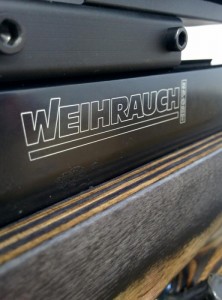
The Marque of distinction
From here multiple other rifles and pistols have been produced over the years such as the Weihrauch HW45air pistol which was another German and American collaboration with the Americans designing its classic Colt 1911 styling, and Weihrauch producing the internals. The internals are quite unique to the HW45 as it features a dual power cocking system which has made it a favourite amongst target shooters and pest controllers.
The HW70 led a few years after this pistol which features very similar styling, but with a more target orientated single stroke pneumatic firing system which has minimal recoil to improve consistency.
HW77
TheWeihrauch HW77 was the next milestone rifle to come out of the Weihrauch factory and was an under lever rifle which had become incredibly popular amongst target shooters in Europe and the UK. This rifle didn’t sell well in America, though, as it had a modest power output compared to the HW80. The HW77 is available in both standard and carbine lengths and the direct barrel loading system were rather innovative for its time, which massively improved accuracy compared to other models of its day. The sporter style stock was perfectly designed for shooting with a scope which target shooters absolutely loved, and still do to this day. After the great success of the HW77, Weihrauch produced another underlever air rifle but with a larger compression chamber, larger selection of stocks and finishes and without any open sights, called the HW97. This is more inclined towards serious hunters and target shooters as it is a large, heavy rifle but is superbly accurate and can be fitted with a sound moderator to reduce the heard muzzle blast.
HW90
The Weihrauch HW90 was the next rifle to come from Weihrauch, and this time it was a collaboration with the old English airgun company Theoben, and includes their most notable airgun innovation, the gas ram system. This system offers multiple advantages over the conventional spring such as lower recoil, no loss of power over time, and increased accuracy and consistency. The HW90 had a classic sporter stock and has been a firm favourite over the past years with hunters and pest controllers thanks to its high power output and fantastic build quality.
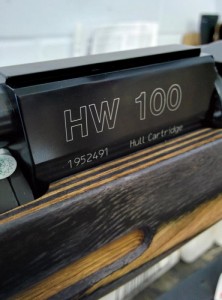
Weihrauch HW100
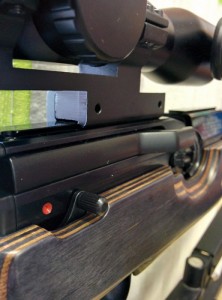
The Weihrauch HW100 laminate up close.
Weihrauch have also in more recent years been a pioneer in the world of Pre Charged Pneumatic airguns with their HW100 rifles, and the HW110. The Weihrauch HW100 is a multishot PCP rifle with a side lever action which Weihrauch were one of the first to develop. A 14 shot magazine loads the pellets and an anti-double load system makes the rifle more usable and safer than others on the market. One of my favourite features of the HW100 is the Weihrauch barrel fitted with one of Weihrauchs high efficiency silencers which makes the rifle so quiet, you sometimes don’t know if it has fired or not. The HW110 is the latest PCP rifle and has a 10 shot magazine and a synthetic stock and comes at a lower price than the HW100 and has already been a big hit with consumers and the airgun press.
A Marque of Quality
Weihrauch never forget their high quality standards and examples of their products just keep working and working. I personally have a HW35 which dates from the 1970s, and despite its physical appearance the accuracy is phenomenal and I wouldn’t change it for anything!
With our store selling everything from compound bows to arrow quivers, it seemed only fair that we interview someone from the world of archery, for the avid and passionate fanbase that buy our products.
That’s why our correspondent Hazel Randall talked to archery instructor, Andrew Hood, nine-times winner of the Norfolk Championships (in consecutive years), founder-owner of the successful archery training and advisory business, Feathers and Fletchings, based in Worstead in Norfolk, and proud owner of a banana-yellow Triumph 955 RS.
Andy – tell us about Feathers and Fletchings.
We do archery-related stuff. We’re archery coaches, mainly. We run sessions for schools and colleges, activity centres, sports centres … that sort of thing. We provide private coaching – that’s the really intense stuff for competitive archers – and we do a lot of these two-and-a-half-day Archery GB Instructor courses. Hopefully that’s a sign of increasing opportunities for youngsters to learn archery.
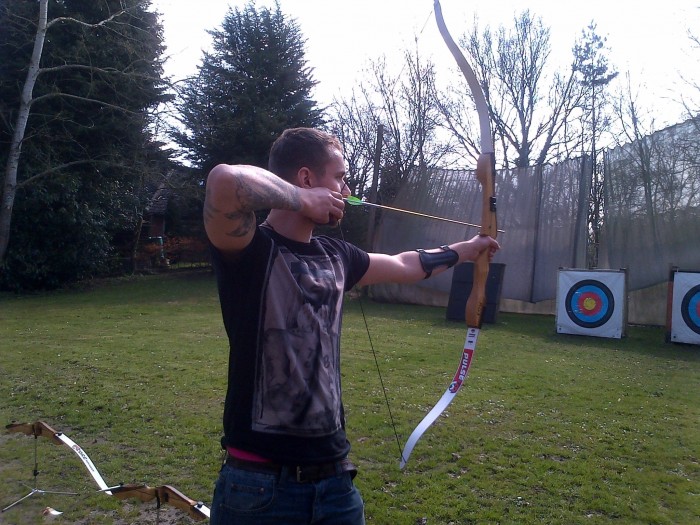
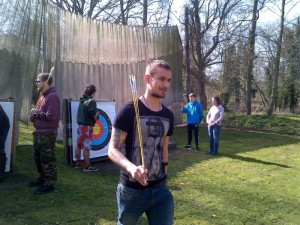
We’re technical advisors to Hautbois Activity Centre in Coltishall, and a number of other centres across the country. We provide information and guidance regarding industry compliance, teaching practices, personal safety, range position … and we organise their staff training.
Is the arrow wrap product Fletch-o-Set your own design?
Yes – I’m an inventor!
The arrows we usually use for teaching are made of aluminium. Now, there’s a natural oxide layer on the surface of metal that delays corrosion, but to thicken the oxide layer and increase resistance to wear and tear and corrosion, the aluminium is anodised. Are you keeping up?
Just about.
Good. Well, the anodising process leaves the aluminium slightly oily, which makes things very difficult when it comes to sticking on the fletchings. That’s where Fletch-o-Set comes in. It’s a strip of vinyl with an adhesive backing that’s wrapped around the back portion of the arrow shaft, forming a barrier between the oily surface of the metal and the glue that attaches the fletchings.
We can print whatever you like on your Fletch-o-Set strips – a club’s or sponsor’s logo, for example – so it serves a proprietary purpose as well.
Do you teach people with physical disabilities?
Yes, we do. There are ways to accommodate students with disabilities, and this is actually a big part of the GB Instructor training course.
Equal opportunity is key. I’m not talking about equal or uniform treatment. You need to treat people in very different ways if you’re going to provide them with the opportunity to achieve equally. We train instructors to assess the needs of individuals and to provide the help that they need.
I’ll give you some examples: a blind archer may need a tactile sighting aid; an archer with only one arm may need someone to lend a hand in holding the bow or some form of mechanical device to pull and release the string; a wheelchair user may need a little help in manoeuvring the wheelchair.
As an instructor, you have to be aware of different needs and you have to be constantly developing the skills to adapt your lessons to these needs. I’ve worked with severely abused kids. Their perception of right and wrong – i.e. the consequences of ‘doing something wrong’ – is sometimes warped, and can be detrimental to learning. Reassurance and consistent treatment will help to free a child from the bonds of fear. Sounds a bit fluffy, I know, but fear is restrictive. Take social anxiety – a perfect example.
What were you doing before wielding bows and doing archery-related stuff?
Until eighteen years ago, I was an engineer, working in steel fabrication. One particular job I’m very proud of is the design and construction of the enormous steel brazier that contained the first millennium beacon, lit by the Queen.
I know that you care deeply about giving children the opportunities they deserve. Can you tell us about Kids With Cake?
Well, it’s a simple system whereby a proportion of our turnover is siphoned off for the purpose of providing free sessions for disadvantaged kids who wouldn’t otherwise get the opportunity to have a go at archery.
The name comes from an experience I had when teaching after-school archery sessions at a school for ‘difficult’ children. It’s a long story. It’s on the website of one of my other companies. (click here for more).
While we’re talking about kids with cake, I might as well mention the Big Brownie Tea Party in August 2014. I taught an archery session in the garden at 10 Downing Street with 100 brownies – and David Cameron!
Have you ever taught archery abroad?
Yes, a few times. And I’ve also been taught abroad. I had a wonderful experience at the US Olympic Training Centre in California. I was trained by head coach, KiSik Lee, and was awarded Level IV Performance Coach status. I’m not a big-headed person, but I’m really proud of this achievement; there aren’t many coaches outside the US who are trained and qualified to this level.
The laws of physics, as defined by Scottie in Star Trek …
(Andy has an exceptional knowledge of human behaviour and the psychology of learning. He also has an in-depth understanding of the science of archery. He hides his intelligence pretty well, though, behind humour and brusqueness.
When I asked Andy for a business card, he said he couldn’t find any, but he produced, instead, four playing cards – all Kings of Hearts. Then, at point blank range, he performed card tricks that had us all gaping. He told us about his magic tricks.)
Sometimes a group of kids will get restless. You might have children wandering away, others being noisy – and maybe a quiet kid is left out. That’s when I bring out the card tricks. It’s like a magnet. They gather round, totally focussed – and unified in one activity.
(The four playing cards turned out to be business cards!)
At Pellpax, we work hard to ensure our staff expertise is some of the best in the industry, so they can provide excellent customer service. We believe training is vital.
Our very own James Hancock carrying arrows back from the target.
That’s why, in April this year, Pellpax sent three of the archery shop sales team – James Hancock, Chris Roberts, and Jake Kirk – to Eaton Vale Scout and Guide Activity Centre in Norwich to take the Archery GB Instructor Course. It was led by highly knowledgeable official Archery GB instructors Andrew Hood and Abbie Stewardson. Blogger and writer Hazel Randall joined them to participate and observe proceedings….
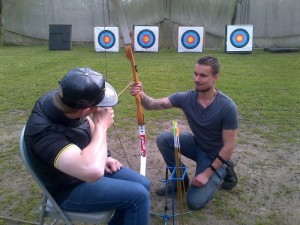
I was delighted to be included in the event. Everyone on the Archery GB Instructor course was there to learn how to teach archery to a group of beginners. The instructor, Andrew Hood, demonstrated a beginners’ session.
Andy is not only an excellent archer – he’s a first-class teacher. Understanding that experience shapes the way we perceive and interpret the world, Andy adapts his sessions to the needs and ability of each student. His instruction has a fluid quality that reaches the most distant individual.
Introduction
Andy introduced himself – name and credentials – and asked for the names of all the students. He told us that the aim of the session was to learn how to shoot. We were asked if we had any medical conditions that might affect our shooting. “You don’t need to shout it out,” Andy told us. “Just come and tell me privately.”
Andy then asked the students about archery experience. If a student has had a go before, then preconceived knowledge and learnt behaviour may affect their ability to follow instructions. In this case, particularly, experienced performance shooters posed the greatest challenge. This course was not about shooting well – it was about learning (or relearning) each minute step of archery protocol as set out by Archery GB.
Our own James Hancock, holder of many shooting titles, had the difficult task of temporarily shedding his ingrained, automatic habits in order to adopt new sequences. James told me that many
James takes aim
aspects of this course were enlightening, in that he became aware of details that needed to be explained to beginners – details so familiar to James that he was unaware of their importance to a novice.
It is important that an instructor fully understands every aspect of the activity – far more than he will ever share with his students. Andy told us what we needed to know, when we needed to know it. He didn’t overload us with information, and he repeated each point clearly.
After the introduction, everyone trooped from the classroom to the archery range. As he gathered his equipment together and pottered into the sunshine, Andy whistled softly to himself. By the time we were all gathered together, two other people were humming or whistling that same tune. His natural charisma and leadership were infectious. This happened on two other occasions, and when I mentioned it to Andy, he said, “You see how easily people are influenced by what they hear; they probably don’t even know they’ve heard it.”
The waiting line
Andy told us that the waiting line is a rope stretched across the range, parallel to the targets. Its purpose is safety. The rule is: don’t cross the line until your instructor invites you to do so. If you cross the line once, you receive a warning. If you cross it a second time, it’s an early bath!
Tell students what to do – don’t tell them what not to do
Andy explained: “Running on the archery range is strictly forbidden. So don’t run makes sense – until your students are hopping, skipping, and jumping all over the place, and your life suddenly becomes a nightmare of blood, death, and paperwork. The correct way to move around on an archery range is to walk. So the best instruction to give students is: walk.”
Chris Roberts from the Pellpax team takes aim at archery targets
The bracer
A bracer protects the shooter’s inner forearm from the bowstring. The word bracer is probably unfamiliar to young children, and easily forgotten. The term arm guard carries overtones of danger and pain – why else would you need a guard? So Andy referred to the bracer as an arm thingy; it’s just a thing you put on your arm.
We were asked to hold up the hand we write with (remember that these sessions are designed for children), and a bracer was put into our dominant hand. We were shown how to put the bracer onto the opposite arm (the one that holds the bow). To check that we were wearing the bracer on the correct arm, we were asked to raise our dominant hand again, to check that no bracer was being worn on this arm. (In case you’re wondering – yes, there was at least one!)
Arrow length check
Arrow length is an important safety check. It is safest for everyone to use long arrows, avoiding the possibility of somebody tall using an arrow that is too short.
The Pellpax archery team learning about arrow length
A person’s arm span is virtually equal to his own height. So a tall person will have a longer arm span than a short person. When an archer draws back his bowstring, the longer his arms, the further back the string (and arrow) will go. So if the arrow is not long enough, it will be drawn back beyond the riser (middle section of the bow). There have been some very nasty accidents involving pierced hands and arms, caused by using short arrows.
The shooting line
When students are introduced to the shooting line, understanding the rules is crucial for safety. Students might be told: stand behind the line. But what does this mean?
It might mean, stand anywhere behind the line. But if a student shoots from a couple of feet behind the line, others – who are standing forward of the shooter but behind the line – would be in danger. Stand behind the line might mean, put your toes on the line and face the target. In this case, an extra lesson must be taught in taking up the correct position.
Although the idea of the shooting line is to be behind it, Andy finds that the clearest and safest way to teach this element of archery protocol is to instruct students to stand with feet parallel, one either side of the shooting line, the arm-brace arm towards the target.It is made clear that only one foot is over the line and that equipment is not to be handled until you are in this position.
This choice of words results in a steady stance, a safe shooting position, and elimination of the risk that a student will wander around with equipment or step over the shooting line.
Jake Kirk from Pellpax takes aim.
The STOP command
The STOP command is for potentially catastrophic situations. Anybody on the archery range can call it, and the command must be acted upon immediately. If an archer is at full draw when the STOP command is given, he must abort that shot. The first step is to point the drawn arrow at the ground in front of you. At this point the string tension must be released.
The terms release or let go may suggest following through with the shot, firing the arrow into the ground. But push the arrow forward describes the controlled manner in which an archer should keep hold of the arrow and slowly ease the string tension until bow and arrow are held separately, at which point they can be returned to bow stand and quiver.
Demonstration
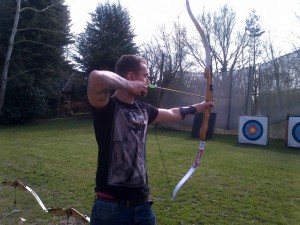
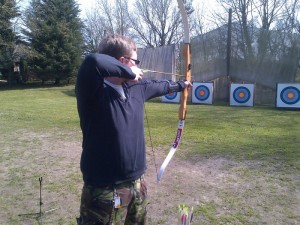
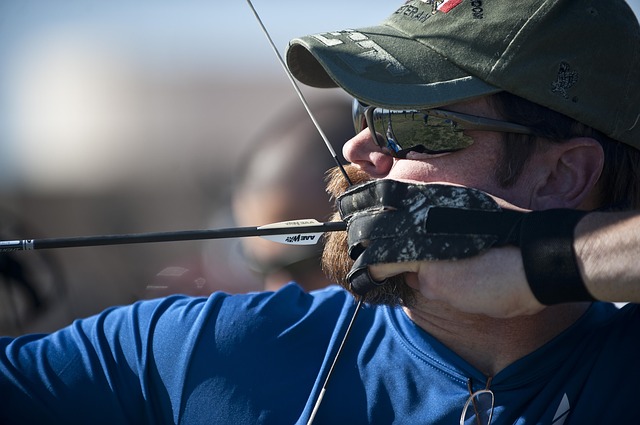
Standing in the correct position, Andy picked up the bow and an arrow. Holding the bow in front of him, and keeping the arrowhead facing the archery target (i.e. away from everybody), he slid the arrow up the right side of the bow, over the top, and down the left side of the bow. A left-handed archer will do this the opposite way round (left to right).
He then fitted the nock onto the bowstring between the nocking points, and with three fingers (fore, middle, and ring) underneath the arrow, drew the string back until his forefinger touched the
An Arrow between nocking points.
corner of his mouth. He aimed and fired. This demonstration was done with commentary. Andy went through the process again, but without speaking. Our visual learning was now brought to the fore. Andy explained the power of visual experience by suggesting a scenario.
“Children are passing by the archery range en route to a canoeing lesson, and they happen to witness an archer walking straight from the shooting line to the target in order to retrieve his arrows. The children don’t really register what they see – they’re thinking about canoeing. But they’ve seen it; the memory is made.”
Guided shoot
Individually, we were guided through the shooting of three arrows. Physical guidance can be valuable in teaching. Having limbs put into position and torso turned at the right angle can give the nervous system a head start in the learning of new moves.
Retrieval of arrows
Following the instructor, we filed round the edge of the range to the targets. When you extract an arrow from the archery target, you need to consider three things. One: do minimum damage to the fabric of the target. Two: reduce the risk of losing the piles (arrow tips). Three: don’t stab anyone.
Andy placed a hand flat on the target, with the arrow between forefinger and middle finger(“or middle finger and ring finger if that’s more comfortable”), looked behind him, and pressed against the target as he drew the arrow out. This method of retrieval protects the target from tearing, and if the pile has come free of the arrow, you’ll find it wedged between your fingers. Looking behind you, of course, will prevent you from stabbing anybody!
After pulling our arrows from the archery target (or picking them up from behind it), we walked straight back to the shooting line (across the range), the arrows held in one hand, resting over a shoulder. There followed a period of free shooting. Andy asked us questions that tested our memories of what we’d learnt. There followed a review of the session from a teaching point of view.
Open and closed questions
Andy talked to us about open and closed questions. “Ask a group of kids, did you enjoy the session? and you know that the answer will be yes. Children know that’s what you expect to hear; they know that’s what their peers will say; they know there’ll be some sort of fuss or attention or adult fretting if the answer’s no.
But questions like what did you enjoy about the session? / what did you find difficult? / why did we teach you about the waiting line and the shooting line? produce thought-driven answers.Just as an ill-chosen phrase can give wrong (or ambiguous) information, so a badly worded question can smother real communication in pointless platitudes.”
Be specific
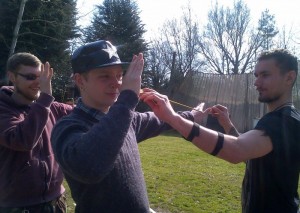
Andy demonstrated the importance of choosing apt vocabulary. We were asked to hold up our hands at face level, palms facing each other, a head width apart. Then we were asked to close our eyes and move our hands apart a little bit. When eyes were opened, it was obvious that interpretations of a little bit varied hugely – from less than a centimetre to about fifteen centimetres.
Presentation
Andy spoke at an even pitch and speed, and his delivery was clear and audible. He never conveyed impatience or stress or haste. Certain phrases were repeated several times over, allowing students to grasp new facts that might otherwise have skimmed over our consciousness like a miss-fired arrow. The day was enjoyed by all of the Pellpax team, and we all felt we had developed a knowledge of how to guide and instruct young archers taking their first steps.
This month, Steph Brooks from the Pellpax team takes time out to review two highly prized mid-range airsoft pistols. Read on for more….
I’m taking a break from firearms this month, and reviewing two great bb guns in the shape of the KWC Desert Eagle and the Tokyo Marui Sig P226. Airsofting has become a major sporting activity, with sites springing up all over the country thanks to the large number of people willing to give up their weekends and evenings to skirmish though a boggy field or an abandoned industrial estate. With its growing popularity and thanks to the competitive nature of the activity, the best equipment is essential, so let’s try and decide between these two mid-priced pistols to help you get the edge over the competition.
Looks
In terms of appearance both of these pistols look very similar to their live firing counterparts. The Tokyo Marui P226 is more of a police/military style pistol whilst the Deagle has more of the Dirty Harry “Do you feel lucky punk?” factor and is certainly larger and more exiting to aim, feeling like it is capable of doing some real damage.
Both of these pistols feature an ABS plastic body with metal internals, such as the gas blow back system and magazine. This struck me as somewhat of a downside on the P226 where its smaller frame could surely support more of a full metal body and make this pistol feel more like the real thing. There are also noticeable mould lines around the P226 and whilst these are easily filed away, they make the pistol look more like a toy than a real firearm. The Desert Eagle already weighs nearly 2 kilos, so maybe a full metal construction would not be the best idea but I would have liked to have seen the classic chrome finish on the barrel and slide, to make it look more like its iconic live firing counterpart.
As I have stated before, to me, looks are nowhere near as important as how a gun handles or shoots but if had to pick a winner based on the appearance of these two I would go for the Desert Eagle thanks to its larger shape and construction. Both of these pistols look like bb guns and although the plastic is strong, I can’t help but feel that more metal would benefit the aesthetics of both these pistols.
Winner: KWC Desert Eagle
Operation
Both of these pistols operate with a gas blow back system which means that when fired the slide of the gun is pushed back by the gas and chambers the next bb for realistic operation and recoil. This does mean that some of the energy from the gas released is diverted away from the power required to propel the BBs out of the chamber. On other hand, does make these guns feel far more realistic than their static alternatives, with realistic recoil and kick.
The safety of the KWC is ambidextrous and easily accessible. It does lack that distinctive click clack engage/disengage noise but hey, it does the job. The P226 has a slide lock but lacks any safety switch of any kind which had me sometimes disengaging a safety that wasn’t there and at first, seemed somewhat of an over sight to me. However, after some research I discovered that the live firing version also lacks a manual safety switch, and can only be fired when the trigger is pulled thanks to some clever internal pin locks. I have been carrying the P226 in a holster all day and have never had it go off when I wasn’t expecting but would still prefer a manual safety switch. Maybe it’s a psychological thing, but with the KWC I know when that switch is engaged there is 0% chance of it firing, and with the P226 there was always a niggling thought in the back of my mind.
The P226 features a rail on its underside near the trigger guard, which is ideal for a laser or torch, and makes installation easy. The P226 is probably second only to the 1911 in terms of aftermarket accessories with springs, barrels, piston heads and body panels all available to tailor the pistol to suit your specific needs or desires. The KWC is without rails of any kind and its iron sights are not as precise or well-made as the P226, as they are without white dots or fibre optics which makes aiming, particularly at white targets, a tad trickier. The Desert Eagle also has nowhere near the same amount of options in terms extra parts.
The magazines of both pistols are relatively easy to fill with both bbs and gas with and thanks to their all metal construction both feel exceptional sturdy and lock into place with a satisfying clunk. The magazine of the KWC has a bit of lateral movement, but not much and certainly not enough to make feel as if the magazine was in any danger of falling out of position.
The grips of both pistols are made from stippled abs plastic and provide a sure hold, even under recoil, both in the naked hand and with airsofting gloves on. I would be interested to see if they are so easy to grip after a couple rounds in the rain or when coated in mud, but this will probably be more affected by your choice of gloves than the pistols themselves. The P226 fits the hand better but that is just generally a size issue, rather than shape or design. Not that the Deagle is too big or in any way cumbersome, but unless you are Andre the giant it is unlikely that you will be able to wrap you fingers all the way round it. The Desert Eagle is from the family of guns that perceive bigger as better, it is meant to feel powerful in your hands, but this does have a few drawbacks, and it is worth researching your holster before you buy it, as the Deagle will not fit into them all.
I think I’m gonna have to give this to the P226. Its lack of safety will take some getting used to, but the fact that it can reliably fit into any sized holster, and its extra customisation options make it more universally suitable.
Winner: Tokyo Marui P226
Performance
I tested both guns from a distance of 10 metres inside an indoor range to eliminate wind, temperature or elevation changes from effecting results, and first of all I have to say that both these bb guns are extremely fun to shoot. The P226 has got to be one of the loudest gas pistols I have ever fired. Some may see this as a disadvantage for giving away your position but I must admit, at the range it left a big smile on my face thinking “this thing hits hard”. The KWC features a slide that features strong feedback whenever the trigger is pulled which undoubtedly affects accuracy but makes this pistol feel like an absolute cannon which is, of course, extremely enjoyable. In reality both pistols shoot at around 300fps, but the KWC definitely feels the more powerful with its heavier recoil.
In terms of accuracy the P226 edges it with a grouping of around 2”, as always, ignoring a couple of outliers that were shot at the start of the magazine and were just me getting my eye in. Three of the holes were actually double taps and all shots landed within 1.5” of the bullseye. The Desert Eagle, ignoring a couple of outliers, grouped at around 2” also but with no double taps and a greater spread between the pellets, particularly in the vertical plane. This leads me to conclude that although both guns are comparable in terms of accuracy on the day, the P226 might just be the more consistent when it comes to hitting the target.
The trigger of the P226 features a long length of pull, a long reset and quite a sudden break, which does take a bit of getting used, to produce accurate results. The trigger action is consistent and doesn’t feel flimsy or unresponsive, it is just somewhat longer than I was expecting and I suspect that has something to do with the safety mechanism I mentioned earlier but, nonetheless I’m sure it won’t be for everyone. The trigger of the KWC is harder to pull but has a much shorter length, which makes the pistol seem more responsive.
Another thing to consider is that the P226 cycles much quicker than the Desert Eagle and I was able to empty the magazine far quicker when shooting with it. Part of this is down to the heavier kick of the Deagle taking longer to realign my aim after shooting, but even just blind firing the difference in speed is noticeable and something to consider if trying to aim at a moving target when your window of opportunity is small.
Despite having great fun with both of these pistols I think the winner has to be the P226. In terms of accuracy is was marginally more precise and the quicker cycling speed allows you to get your shot off when you need it.
Winner: Tokyo Marui P226
Conclusions
In summary, both of these pistols do an adequate job of being back up to your airsoft rifle or as a primary weapon in CQB engagements. Both pistols fire reliably and in my testing I encountered no problems with either of them. Both airsoft pistols are extremely fun to shoot and provide great feedback thanks to their gas blow back system. In terms of airsofting both of these pistols are accurate and reliable and can be drawn and fired in an instant and could give you the edge over the competition.
Since I have to pick a winner, I give it to the P226 because, despite its lack of safety and somewhat Marmite trigger, I found it to be more accurate and it offers a bigger range of extras if customisation is your thing.
So you’ve bought an air rifle, now how do you take care of it? Have you got a gun cleaning kit and know how to use it? Care and maintenance is a vital part of the process of owning and using an airgun, and here Ross Mitchell of the Pellpax team explains what you need to know to keep your pride and joy in the best condition.
Air rifles contain many internal mechanisms which correspond together and allow us to shoot. Therefore it’s very important to know how to clean and maintain your rifle in order to keep it working at a high quality. There are many parts which make up an air rifle and most of them need some form of cleaning and maintaining. Here, I’m going to go through each part in detail discussing how to clean and maintain these various component parts, without damaging them.
An air rifle barrel can be cleaned by firing a cleaning pellet, or using a cleaning rod.
The Barrel (Internal)
Airgun barrels do get dirty but don’t need cleaning 24/7.The main problem that occurs with barrels is a build up of oil or deposits of metal from firing pellets. Oil is common in a spring rifle and often gets in the barrel from firing pellets. The one rule of thumb to bear in mind is that y0u should never oil your barrel. If you oil your barrel it can get inside and damage the mechanisms. Another problem that could occur if you oil your barrel is dieseling. This is where the oil combusts as you fire a pellet through the gun, and over time, this process can damage your seals and result in loss of air in your rifle.
Summary:
Never oil the barrel and don’t clean it too much or you risk damaging it. Ideally clean after you finish a tin of pellets, by either firing a cleaning pellet though it or using a cleaning rod.One cleaning pellet after every tin of pellets will be enough to help maintain the barrel.
Barrel (External)
Just like the inner barrel, the outer barrel needs to be maintained. The metal is prone to rust and wear, so it is important that you look after this, to help keep your gun looking and performing to a high standard. Whenever your barrel is exposed to water it is important to get a cloth and dry it. Water can damage and rot wood and metal work so it is important to do this. You can also purchase rust protection spray or silicon gun oil. Either apply a light coat of spray over the metal work, or get a cloth and apply a thin layer of silicon gun oil after every use. By doing these regularly, your barrel will be protected against rust and wear and remain looking brand new.
Summary:
Wipe water or oil off the gun, whenever it comes in contact with it. Apply a light coat with the spray or a thin layer of oil on a cloth and wipe down after every use.
Scope
It is just as important to maintain the scope as it is to maintain as the rifle itself. A neglected scope can cause problems when trying to line up your shot. Scopes are very easy to maintain and care should be taken if your hands, the rain, oil,. etc. come into contact with it. Dust can be removed with a soft cloth or compressed air and this can be done whenever it is needed. The two things to check for is that the cloth is smooth, and will not scratch the lens and, secondly, to check it has no oil or grease on it first. Water, finger or oil marks on the scope can be eliminated by simply wiping with a microfibre cloth.
Summary:
Scopes can be cleaned as often as needed. For dust use soft cloth, soft brush or compressed air. For marks use a soft microfibre cloth and rub in a circular motion.
Woodwork
Wooden stocks are striking and pleasing to look at, but require maintenance
One thing that attracts people to air rifles is the beautiful woodwork that usually distinguishes their exterior appearance. Rifle stocks come in many varieties of wood including beech, walnut, hardwood and many more. Although varnished, over time the wood can show the effects of ageing, such as wear, tear, dullness, etc. You will wish to guard against this, particularly if you have an expensive rifle, such as a Daystate or an Air Arms. The good news is that woodwork is very easy to maintain, if you’re willing to put the time in. It’s as simple as wiping your gun down when it’s been exposed to rain because water can cause damage and rot, if parts of the woodwork aren’t varnished. Also you can varnish your woodwork with a stick finish. This will give it a high quality sheen finish whilst also protecting it from mild impacts.
Summary:
Wipe wood dry after it’s been in contact with water to prevent rot/damage. Use stock finish to varnish and protect against knocks.
Action
The stock offers a comfortable yet firm support when firing your rifle. It allows you to get a steady aim but also acts as casing for the internal mechanisms. Although wiping the stock will protect it, people don’t realise water can get inside the stock and cause all the mechanisms to rust and seize. To prevent this problem simply remove the stock casing using the appropriate tool and put a tiny amount of oil inside the action. Use a gun oil and not motor oil! Motor oil is too thick and can slow/seize the internal mechanism, as well as soak and soften the wood.
Summary:
Apply a small amount of gun oil to the action. Never use car oil as it is too thick.
Use degreaser spray on the trigger mechanism. For the best results, consult a gunsmith.
Trigger
The trigger mechanism is very important to a rifle. Most people prefer to take their rifle to a gunsmith to do maintenance work on this part, since if done wrong, it could prevent the gun cocking. If you want to do anything, you can take the casing off to reveal the internal mechanisms. After this you can use a degreaser spray on the trigger mechanism and then re-oil the appropriate areas. If you don’t feel confident doing this or you want additional work to be done on the trigger, it’s best to take it to an experienced gunsmith.
Summary:
Take the side of the gun using appropriate tools. Either oil the mechanism or use degreaser spray and re-oil the mechanism.
General Advice
There are a few general things you can do alongside these tips to prolong your air rifle’s life and appearance. When storing your rifle it should be in a dry place that has no risk of water or other chemicals coming into contact with it. A wipe down after every use to remove grease, finger marks etc., will help to keep your weapon in good condition. Transporting and securing your rifle in a gun bag will protect it from knocks and general wear. If you stand your rifle upright it should be stood on the stock and not the barrel.
My final bit of advice would be to regularly get your gun serviced. Taking this step will ensure it continues performing at a high rate and prolong the overall life of your rifle. The frequency with which you should get your air rifle serviced depends upon how often you use it. If you’re like me and go shooting once or less a week, then a service every two years will be enough.
However, if you use it more regularly then you will need to get it serviced once a year. If at any point you feel your gun is not performing like it should, or you think something might be wrong, then you should consult a professional. It’s better to be safe than sorry, because if there is a problem, and it isn’t addressed, it could get a lot worse.
Pellpax Darren Kirk congratulates Huge Giveaway winner Peter on his prize.
In March we announced our very first Huge Giveaway. A mammoth prize of nearly 60 different parts, including 3 airguns, lots of outdoor gear, archery equipment, and a break at an exclusive hotel! It’s a prize which is unprecedented in the industry, and one of the many reasons our customers love us. The competition ran for one month, and all you had to do to win, was to make a purchase of more than £25. For every additional £25 spent, a further entry was made.
The great news is that we effectively received thousands entries during a 2 week period, thanks to the purchases made. And now it’s time to announce the winner!
The lucky recipient of all that Pellpax goodness is Peter, a customer from Surrey. Our Director Darren Kirk went out in person to hand over the goods to the man himself (pictured).
If you’re passionate about the outdoors and want to learn more about survival skills and bushcraft, then this short primer will help to give you a few pointers on how to fend for yourself, and enjoy those nights under the stars.
Corkscrew
The Sportsman by Victorinox is a versatile multi tool.
The tighter the knot, the stronger it holds. But the tighter the knot, the harder it is to undo! The corkscrew on the Sportsmanby Victorinox is the perfect tool for undoing tight knots. Weave the corkscrew into the knot and coax the threads apart.
Clamps
A useful component of a survival kit is a handful of heavy-duty tarpaulin clamps with metal eyelets. Taking a firm grip on fabric, these clamps add stability to a tent in bad weather or provide anchorage for a makeshift shelter.
Water Strainer
If there is no clear water to be found, use a tightly woven piece of cotton fabric, like a T-shirt or bandana, to strain mucky water. The cloth can be repeatedly rinsed and reused.
Honey
A gauze pad spread with honey is an excellent dressing for infections and burns. Honey is antibacterial, antiviral, and anti-fungal. Dr Susan Meschwitz, who led research into the healing properties of honey, said, “The unique property of honey lies in its ability to fight infection on multiple levels.” In cold weather, though, honey will crystallise and will have to be warmed before use.
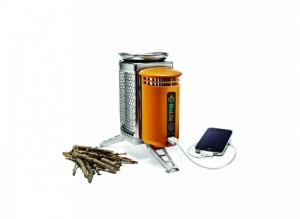
The Biolite CampStove has all kinds of uses.
Firelighters
Commercial firelighters take up quite a bit of space when you’re travelling light. Here are some superb ideas for homemade (and cheap) firelighters. Save remnants of wax candles and melt them over a BioLite CampStove, which is fuelled by twigs and pieces of wood. Coat some cotton pads or cardboard strips with the molten wax. When the wax has set, keep these firelighters in a watertight bag until they are needed.
Root cordage
When in need of emergency rope, excavate the thinner tree roots that are to be found near the surface of the soil. Strip off the bark, and the roots can be used straight away for binding. The Classic SD by Victorinox is a handy tool to carry with you for this type of work, along with the Blademedic Knife Sharpener. For tighter binding, the root will need to be dried out first, but wet it before use to make it more flexible.
Bark cordage
For finer, intricate binding, cut strips of willow bark, scrape off the outer bark, and keep these scrapings. Put the strips of inner bark into a pan of water with some wood ash and the saved scrapings of outer bark, and simmer for at least 45 minutes. The strips will now be flexible and durable.
Collecting dew
One of the simplest ways to collect water – when there is a shortage – is to lay a piece of cotton fabric (a tea shirt, for example) over dew-covered vegetation and squeeze the collected water into a container. It is advisable to boil the water before drinking it.
The Lineaeffe Multitool is an excellent piece of kit for survival in the outdoors.
Steamed fish
Make up a hot fire with a good bed of embers. Lay a piece of moss turf on the fire, green side up. Put your gutted and cleaned fish (the Lineaeffe Multitool is a superb bit of kit for this purpose) on the moss, and cover them with another lump of moss, green side down. Leave your fish to steam for about 30 minutes, sandwiched within the moss.
Treatment of diarrhoea
Ingest ground charcoal, which can absorb more than twice its own mass in toxins. To make charcoal, put soft wood into a closed tin. Punch a hole in the top of the tin and put it into a fire, allowing the wood to burn in an oxygen-free environment. When no more smoke is coming out of the hole, remove the tin from the fire and allow it to cool. Grind the charcoal, mix it with water, and drink it. It’s an effective (and by all accounts horrible) treatment of diarrhoea.
Subscribe to our email news letter for more top tips on airgunning, archery, bushcraft, and much more. For all of your survival supplies and equipment needs, check out our online bushcraft store.
This month, we spoke to veteran shotgun champion, John Bidwell. The Suffolk-based shooter is highly respected in the world of shooting, and has won in venues all over the world – from Spain to Australia, Germany to America, and many at home in Britain. In this interview, he shares with us his illustrious shooting career, his conferencing and shooting venue High Lodge, Clay Pigeon Shooting Association, charity work, and much more.
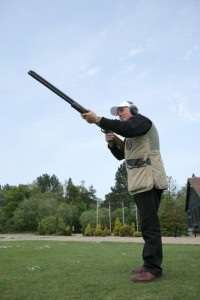
With seven World Championship titles in individual events and 30 years’ participation in the Great Britain shooting team, 68-year-old John Bidwell is still competing at international level in the Super Veteran category. He is the inventor and manufacturer of the Auto Sporter Clay Trap machine and the founding owner of one of the most prodigious shooting venues in the country. John is the author of Move, Mount, Shoot: A Champion’s Guide to Sporting Clays, described as ‘the only comprehensive manual’of the maintained lead method of shooting.
Do you come from a shooting background, John?
No, I don’t. My dad really wasn’t a fan of guns, although he’d worked as an armourer during the war. I got no encouragement from my parents when it came to shooting. I loved the sport, though, and I grabbed every opportunity to practise. In the late 1960s, when I was in my early twenties, I joined a shooting club, and ten years later I was part of the Great Britain shooting team. I’d never had a single lesson!
Tell us about your first shooting club and how you moved on to High Lodge.
The sport had been rapidly gaining popularity during the 1970s, and in 1982, we – my wife, Sally, and I – leased a bit of land at Henham Park in Suffolk, bought some second-hand equipment, and set up our first shooting club. I’d already got this vision of helping to make shooting a more mainstream sport, giving everybody the opportunity to have a go. I did some coaching while Sally ran the clubhouse. I say ‘clubhouse’ – it was a portable hut where members could get a hot drink and a burger!
In 1989, when the lease on the Henham Park land was about to run out, we got the opportunity to buy 100 acres of land at Hinton in Suffolk.
Can you describe High Lodge?
Well, I’m very proud of the fact that it’s one of only a few British shooting venues with a CPSA Premium rating. We’re now a 120-acre luxury resort, catering for conferences and corporate hospitality, short breaks, and celebratory occasions; we do quite a few weddings, actually. I run it with my two daughters, Jane and Helen. Sadly, Sally died in August 2011. She’s very much missed in the shooting world.
A popular feature at High Lodge is our ‘indoor’ outdoor range. Safety cages are incorporated into 12’ by 8’ wooden structures that provide shelter for people and equipment. We have a golf course, which opened in March 1998, an archery range, and two half-acre fishing lakes.
As far as accommodation goes, we’re growing. At the moment we have 19 luxury lodges – with planning permission for an additional 32, which are presently under construction. We have some rather nice function rooms and five-star catering, with extensive parking – and even helicopter landing facilities.
Is the Auto Sporter Clay Trap your own invention?
Absolutely. When we opened High Lodge, all the traps were manually operated, which was restrictive for shooters, because you couldn’t just pop out for a session without booking someone to pull. So, during the following few years, I worked on the production of electrically powered traps. My first model ran off the mains, but eventually we had the Auto Sporter Clay Trap machine, which is still manufactured on site at High Lodge by experienced technicians and engineers. It’s supplied to shooting clubs and competitive events all over the world and is used in conjunction with an automatic counter system.
What is your connection with Blaser, the German gun manufacturer?
Fourteen years ago, Blaser got me to help them design their new F3 model. I showcased the F3 prototype shotgun for sale in the FITASC World Championship in France – and actually won! This was great publicity for the F3. I’ve had a close relationship with Blaser and the F3 ever since.
… And other sponsorships?
I have a long-standing relationship with Eley, the leading shotgun cartridges manufacturer, and I’ve recently engaged in mutual promotion with Lings of Lowestoft and their Mitsubishi L200 truck.
Tell us about your relationship with the CPSA. You’re Honorary Vice President.
The CPSA – that’s the Clay Pigeon Shooting Association – takes good care of its members. But the recruitment of new members is a role typically taken on by clubs like ours. The have-a-go sessions that I organise at shooting events, and the accessibility to the sport that High Lodge offers, open the door to beginners. At High Lodge, a special rate is offered to anyone who joins the CPSA – in fact, High Lodge recruits more CPSA members than any other club in the country.
What’s coming up this year for you?
Okay – I’ll give you a list of events. There’ll be have-a-go sessions at most of these.
High Lodge is well known for its charity events. Is this an important part of your work?
Yes, we’ve hosted many fundraising events for causes like East Anglian Children’s Hospices (EACH), East Anglian Air Ambulance, Cancer Research, The Multiple Sclerosis Society, Macmillan … and lots of others. One particular cause that’s close to our hearts is the care of Guillain-Barré sufferers; this is the debilitating disease that attacked Sally five years ago. We have an annual memorial shoot for Sally. I donated my solid silver World Championship trophy, won in 1996, as the champion’s prize for this event.
John is running a series of ‘have a go’ drop in sessions at his lodge. The dates are.
April 25th-26th: East Anglian Game & Country Fair at the Norfolk Showground, NR11 7WW
June 15th-18th: The Clay Shooting Classic at High Lodge, IP17 3QT
July 2nd-3rd: Country Fair at Heveningham Hall Estate, IP19 0PN
September 1st-4th: CPSA British Open Championship at High Lodge, IP17 3QT
September 10th-11th: Sandringham Game and Country Fair, PE35 6EN
In our continuing series, we take a look at the work of leading airgun manufacturer, Air Arms, and their range of products.
Air Arms are a producer of high quality air rifles, in both Pre Charged Pneumatic, and Spring powered action types. They export their rifles all over the world, and their airguns are used by hunters and target shooters with huge success.
Origins: Sussex Armoury & NSP Engineering
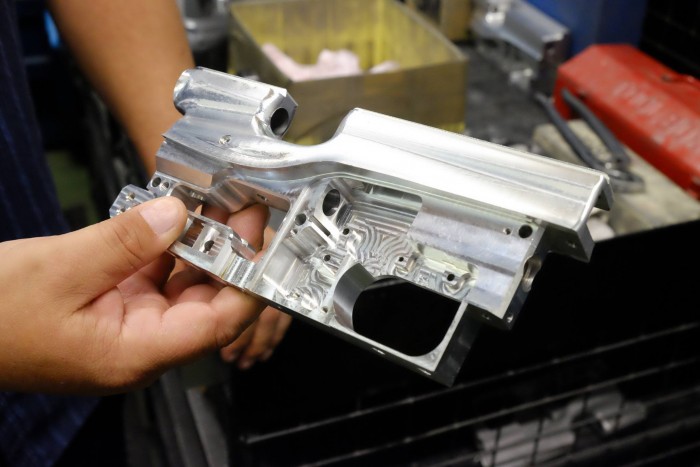
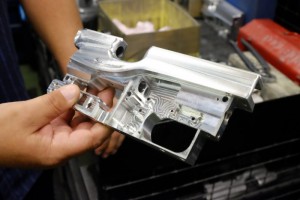
A breech block from a FTP900, fresh off the CNC milling machine.
The company that we know today as Air Arms has an interesting history and company set up. Back in the 1980s there was a company called Sussex Armoury who produced a number of different airguns such as the Jackal Woodsman, and a number of components for that rifle and many others were produced by a local engineering company called NSP Engineering. The Sussex Armoury company then folded in the early 80s, and one of the original three owners of the NSP Engineering, Bob Nicholls, took over NSP.
Air Arms as we know it was born when he then decided to carry on and begin producing his own range of air rifles gained from the knowledge of the sub contract work gained by Sussex Armoury. These were sold under this new brand name, and all of the components were built and assembled at their facility in Sussex.
NSP Engineering still continued to produce Air Arms rifles as well as carrying out sub contract work up until the 90s, until they decided to concentrate on the production of Air Arms and move away from sub contract work. From this point onwards NSP Engineering and the brand of Air Arms has increased dramatically with their rifles now used all over the world, and today Air Arms continue to pioneer the airgun business using the latest in production techniques to produce high quality and technically advanced products.
Cutting Edge Technology
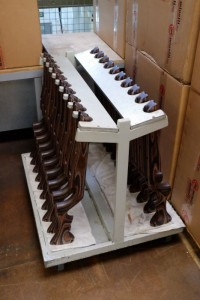
Rifle stocks from Minelli waiting to be mated with the appropriate action
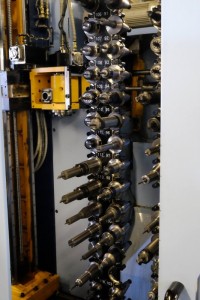
Air Arms use CNC (computer numerically controlled) machines which cut out the metal of solid blocks of material in specific places to produce the components for their rifles. This process is very precise, and as they are produced from one piece of metal the strength is immense. Air Arms also polish all their components on site with polishing machines to achieve a mirror like shine, which is then chemically blued off site to achieve the deep blued finish that Air Arms rifles are renowned for. The stocks are made by Minelli in Italy, of which most gun manufacturers use today to ensure a very high quality finish as well as conformity across the range.
PCP & Hunting Rifles
Air Arms’ range of rifles range from hunting rifles such as the TX200 and S410, right up to the out and out target shooting rifles such as the FTP-900 and MPR Precision. Air Arms have a rifle for almost everyone’s requirements and use, and being based in the UK their production time scale and customer service is absolutely superb.
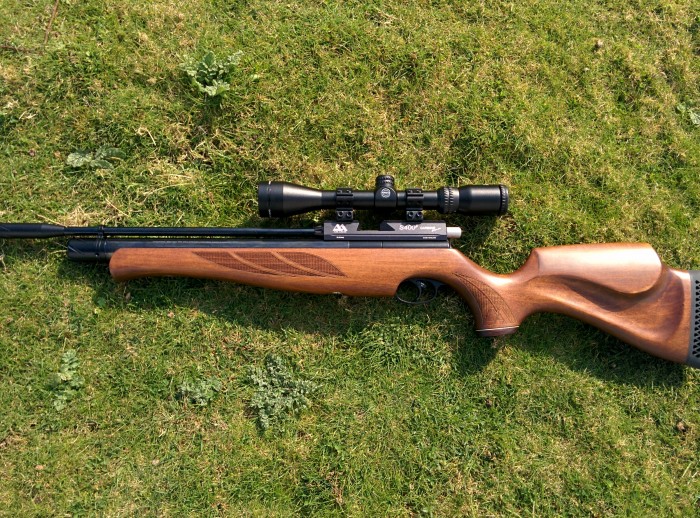
One of their top selling ranges of rifles has to be the S400 and Air Arms S410 PCP air rifles which are tried, tested, and trusted and have been for many years. The S400 is a single shot action, and the S410 has a 10 shot multi shot magazine, hence the ‘10’ in the name. This naming format follows throughout their range. The beauty of the S400 range is they are elegant, very good looking, reliable, and incredibly accurate. The S400 was first introduced in 2000 and has been a massive hit since then. There haven’t been too many changes over the years, apart from in 2010 when a range of superlite stocks were introduced, and some slight aesthetic changes were made to a few parts. A lot of shooters use this rifle for hunting as well as target shooting as it is fitted with a Lothar Walther barrel, as many of the Air Arms rifles are, so accuracy is immense and with a choice of Standard or Carbine lengths there is a model to suit anyone. If you’re looking for a quality PCP that will last you for many years to come, I highly recommend either the S400, or S410. Check out the range of them on our site here…
A slightly improved model based on the S410 series was brought out in 2008 which used a lot of the same components such as the air cylinder, but utilized a side lever action instead of a standard bolt action. This rifle is the S510 and the sidelever action is a lot smoother and positive compared to a bolt and really makes a difference when out hunting as sometimes a quick follow up shot is essential.
One of the CNC machines that is used to create Air Arms rifles.
Spring Powered Rifles
As well as these hunting orientated PCP rifles, Air Arms produce some great springers which are the TX200 which is available as the standard rifle model and a HC (Hunter Carbine) length, and the Air Arms Pro Sport. The TX200 is a standard underlever action which is available in either a Beech or Walnut stock, and the Pro-Sport is also an Underlever, but not in the traditional sense. Air Arms have been very clever and incorporated the underlever into the stock, which keeps the balance right where it should be unlike many other underlevers where the additional weight at the front unbalances it.
The internals of these rifles run on synthetic bearing material which is normally only found on a tuned spring rifle which makes these rifles shoot like a tuned rifle straight from the box. Here at Pellpax we had a Pro-Sport than had come back from a service from Air Arms which was about 2 months old, and it had been chronographed before it was returned, and over a 10 shot string the FPS spread was just 2 FPS!This just goes to show how well made they are and what sort of results they can deliver.
Target Rifles
Of course there is Air Arms’ range of superb target rifles which start with the MPR which all come with Dioptre sights as standard making them aimed towards 10 meter target shooting. These rifles are used by numerous target organizations such as Bisley and the Army all over the UK and Europe to train and compete in competitions thanks to their uncluttered format and reliability. The range then goes up to the HFT-500 which has a multi adjustable laminate stock, which can also be fitted with a hamster/palm rest which is sold separately. The HFT500 has a single shot action with the same side lever which is found on the S510 series. The barrel is a match grade Lothar Walther barrel with a larger air cylinder to increase the shot count.
The pinnacle of the range though is the FTP-900 which features a full adjustable laminate stock which is finished in a luxurious clear lacquer to really accentuate the full colours of the stock. You can tell the FTP900 is designed for competition as it has a windicator arm, a spirit level, air stripper, and palm rest and butt hook all incorporated as standard. Since its release a few years ago it has been a massive hit in multiple competitions around the globe and isn’t being beaten by much at the moment!
If you are looking for a higher end springer or PCP, or a rifle for target shooting then I highly recommend that you consider Air Arms, as I assure you that you will not be disappointed.
Check out the full Air Arms range here, and find out much more about Air Arms on our collections page here.