Getting into shooting is about more than choosing an airgun. Before you start thinking about accuracy, accessories or upgrading your setup, it is important to understand the basics of safe and responsible shooting.
The good news is that getting those foundations right doesn’t have to be complicated.
Whether you’re completely new to airguns or returning to the hobby, taking a little time to understand your equipment, your responsibilities and your shooting environment will help you get more from the hobby in the long run.
Safety Starts With Understanding Your Airgun
The first step is getting to know the equipment you’re using.
Different airguns work in different ways, so take some time to understand how yours operates. Read the manufacturer’s instructions, learn how the safety works and make sure you’re familiar with loading, cocking, charging and unloading before you begin shooting.
Always treat an airgun as though it is loaded, keep the muzzle pointed in a safe direction and keep your finger away from the trigger until you’re ready to fire.
These simple habits quickly become second nature and form the foundation of responsible shooting.
Create a Safe Shooting Environment
Your equipment is only part of the equation. You also need to consider where you’re shooting.
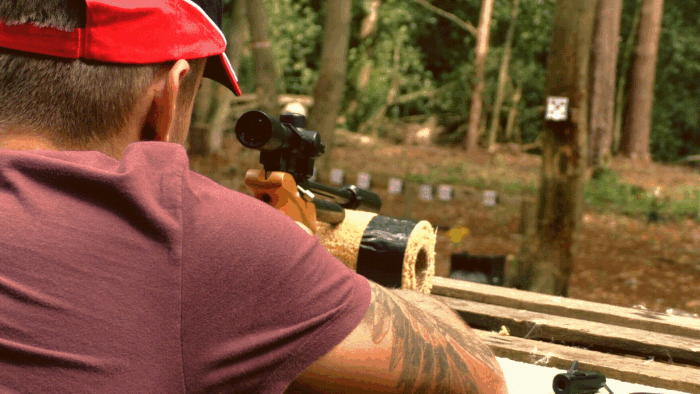
Always check your back stop before pulling the trigger…
A suitable target and a reliable backstop are essential. Think beyond the target itself and consider what is around and behind it. People, animals, buildings, roads and neighbouring properties all need to be taken into account.
If you’re shooting at home, make sure you have a suitable and secure location and understand the laws and restrictions that apply to you.
Responsible shooting means knowing not only where you can shoot, but where you can’t.
Build Your Setup Around What You Need
Once you’ve got the basics covered, you can start building your setup.
You don’t need to buy everything at once. Start with the essentials for the type of shooting you want to enjoy, then add equipment as you gain experience.
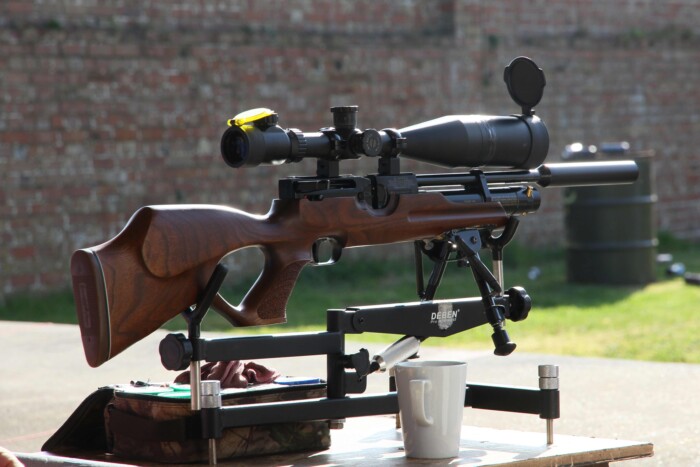
For target shooting, that might mean suitable pellets, targets and a stable shooting position. If you’re using a PCP airgun, you’ll also need an appropriate method of filling it. A scope can help with accurate aiming, while accessories such as bipods, shooting rests and gun bags can make your setup more comfortable and practical.
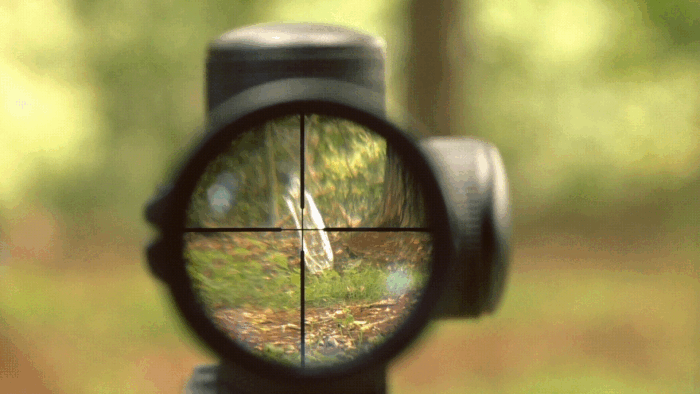
Practice your zero on targets and bottles before pest control.
The right equipment is the equipment that helps you enjoy your particular style of shooting.
Look After Your Equipment
Good equipment should also be looked after.
Regular care can help keep your airgun performing properly and protect it for years to come. Follow the manufacturer’s recommendations and use appropriate gun-care products rather than assuming that more cleaning or lubrication is always better.
As you become more experienced, maintenance can become part of your normal shooting routine.
You may also find yourself developing your setup over time. Trying different pellets, improving your optics or adding useful accessories can all become part of the enjoyment.
A selection of bisley gun care products
Start Safely. Build From There.
You don’t need an expensive collection of equipment or years of experience to enjoy shooting.
Start by understanding your airgun, learn the safety fundamentals and make sure you have a suitable place to shoot. From there, you can gradually build a setup that works for you.
At Pellpax, we offer everything from airguns and pellets to scopes, targets, gun-care products and accessories, helping you develop your setup as your experience grows.
Getting into airguns can feel a little overwhelming at first. There are different types of airgun, scopes, pellets, accessories, maintenance products and plenty of terminology to get your head around.
The good news? You don’t need to know everything at once.
Like any hobby, shooting is something you learn by doing. Start with the basics, get comfortable with your equipment and build your knowledge as you go.
Start With the Basics
One of the first things to understand is the type of airgun you’re using.
Spring-powered air rifles are simple, self-contained and don’t require an external air supply. PCP air rifles use compressed air and are popular for their smooth shooting and consistency, while CO2-powered airguns offer another straightforward and enjoyable way to shoot, particularly for recreational target shooting and air pistols.
There’s no single “best” choice. What matters is finding something suited to how you want to enjoy the hobby.
Once you have your airgun, take some time to learn how it works. Read the manufacturer’s instructions, understand the controls and become familiar with loading, cocking, charging and storing it safely.
Safety First
Before worrying about accuracy, make sure you understand the fundamentals of safe shooting.
Always treat your airgun as loaded, keep the muzzle pointed in a safe direction and keep your finger away from the trigger until you’re ready to shoot. Make sure you have a suitable target and backstop, and consider everything around and behind your target before firing.
If you’re shooting at home, make sure you have a safe and suitable location and are familiar with the laws and restrictions that apply to you.
Good habits are worth developing from day one.
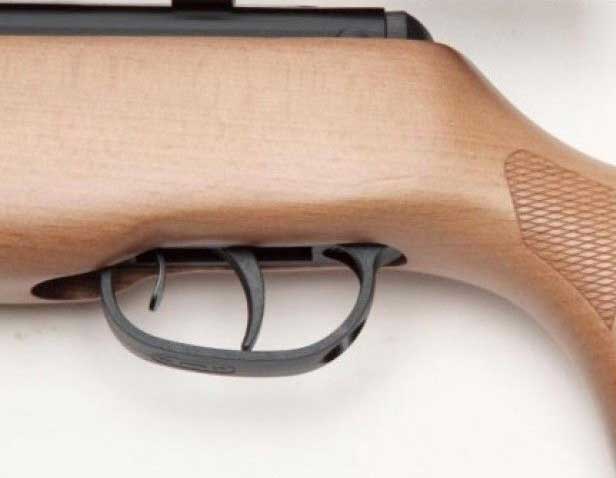
The safety blade of a Remington Pest Controller located just in front of the trigger
Don’t Overcomplicate Your Equipment
It’s easy to think you need every accessory before you can start shooting. You don’t.
A suitable airgun, the correct pellets, a safe target and backstop are enough to get started. If you’re using a scope, learning how to zero it will be one of the first useful skills to develop.
As you gain experience, you’ll discover what you actually need.
You might want to experiment with different pellets, add a bipod or shooting rest, upgrade your scope or learn more about maintaining your rifle. There’s no rush.
Enjoy the Learning Curve
Perhaps the best thing about getting into shooting is that there’s always something new to learn.
Your first targets might not be perfect. Your first attempt at zeroing a scope might take some patience. That’s all part of it.
With every session, you’ll learn a little more about your equipment and your own shooting technique.
At Pellpax, we’re here to help whether you’re picking up an airgun for the first time or have been enjoying the hobby for years. From airguns and pellets to scopes, accessories and gun care, we’re here to make finding the right equipment and information easier.
Setting up your airgun is an enjoyable process.
You don’t need to know everything before you start. Start with the basics, shoot safely, enjoy yourself and let your knowledge grow from there.
Ready to get started? Explore Pellpax and discover where your shooting journey can take you.
Spring-powered air rifles remain one of the most popular entry points into shooting sports and pest control in the UK. They’re simple, self-contained, reliable, and offer excellent value for money – especially at the budget end of the market. In 2026, there’s no shortage of capable spring air rifles under £250, but choosing the right one depends heavily on how you plan to use it.
In this guide, we compare some of the best budget spring air rifles available from Pellpax, looking closely at performance, build quality, ease of use and suitability for different applications such as pest control, target shooting and beginner use. We’ll also highlight where each rifle shines – and where it makes sensible compromises to keep costs down.
If you’re searching for budget air rifles, spring air rifles for pest control, or simply the best value air rifle in 2026, this comparison should point you in the right direction.
What Makes a Good Budget Spring Air Rifle?
Before diving into the comparisons, it’s worth defining what “good” looks like in this price bracket. A strong budget spring rifle should offer:
Consistent power close to the UK legal limit (without exceeding 12 ft/lbs)
Predictable accuracy with quality pellets
Solid build quality that can withstand regular use
Simple, dependable mechanics
Good ergonomics and safe handling
Extras like scopes, moderators and kits can significantly boost value, but the fundamentals always matter more than gimmicks.
Remington Pest Controller Kit (.22) – Best All-Round Pest Control Package
Now £149.99 (Was £199.99, RRP over £235)
The Remington Pest Controller is arguably one of the strongest value propositions on the market in 2026, particularly for shooters who want a ready-to-go pest control solution.
Chambered in .22 calibre and producing around 11.5 ft/lbs, this rifle is clearly aimed at humane pest control. The heavier pellet weight makes it ideal for rabbits and squirrels at realistic air rifle ranges of up to 35–40 metres when used responsibly.
Where this rifle really stands out is the kit. Unlike many budget spring air rifles that ship with minimal extras, the Remington Pest Controller includes:
Upgraded 3–9x variable scope (a major step up from basic fixed 4x optics)
Gun bag for storage and transport
Integrated barrel silencer to reduce muzzle noise
Hunting pellets designed for effective dispatch
Targets for practice
At £149.99, this kit massively undercuts its combined RRP and offers outstanding value for first-time pest controllers.
Best for:
Garden and smallholding pest control
Shooters who want everything included
Budget-conscious hunters
Consider if:
You prefer synthetic stocks or lighter rifles
Gamo Whisper X Swarm (.22) – Best for Fast Follow-Up Shots
£224.99
The Gamo Whisper X Swarm sits at the top end of our “budget” category, but it justifies its price with one key feature: the 10-shot Swarm magazine system.
Unlike traditional single-shot break barrels, the Swarm system allows rapid follow-up shots without reloading pellets manually. For pest control scenarios where a second opportunity matters, this can be a genuine advantage.
Power output sits around 11.5 ft/lbs, keeping it legal and effective, while the full-length barrel shroud significantly reduces muzzle report. The synthetic stock is durable, weather-resistant and well balanced, making it a practical choice for year-round use.
The included scope adds convenience, though many shooters eventually upgrade optics to fully exploit the rifle’s potential.
Best for:
Pest control with potential follow-up shots
Shooters who value modern design
All-weather use
Consider if:
You’re on a tighter budget
You prefer traditional single-shot simplicity
Crosman Phantom (.22) – Best Traditional Spring Rifle Feel
£199.99
The Crosman Phantom delivers a more classic spring air rifle experience, focusing on ergonomics, accuracy and adjustability rather than gimmicks.
Its rifled steel barrel and two-stage adjustable trigger make it surprisingly refined for the price, while the synthetic stock offers durability without excessive weight. Fibre optic iron sights provide excellent visibility, and the included CenterPoint 4×32 scope offers a solid starting point for scoped shooting.
At 11.5 ft/lbs, the Phantom is suitable for both target practice and pest control, making it one of the more versatile rifles in this lineup.
The Daisy Powerline 880 occupies a very different niche to the other rifles in this guide. It’s not designed for pest control, but rather for training, plinking and entry-level shooting.
Its lightweight synthetic build, modest power and dual-ammo capability (4.5mm BBs and .177 pellets) make it ideal for younger or inexperienced shooters under proper supervision. The underlever action eliminates the need for CO₂ or gas, keeping running costs low.
Accuracy is respectable thanks to the rifled barrel, and the adjustable sights allow shooters to learn the fundamentals before adding optics.
Best for:
Beginners and younger shooters
Backyard target practice
Low-cost entry into air rifles
Consider if:
You need a rifle for pest control (look elsewhere)
Hatsan Breaker 900X (.22) – Best Budget Powerhouse
£114.99
The Hatsan Breaker 900X punches well above its price point. Producing around 11.5 ft/lbs in .22 calibre, it’s clearly aimed at pest control, with enough power to humanely dispatch quarry when used correctly.
The integrated moderator, adjustable trigger and solid beech stock give it a more traditional feel than many synthetic rivals. TruGlo fibre optic sights work well out of the box, while the scope rail allows easy upgrades.
It’s slightly heavier and more robust than some competitors, which many shooters appreciate for stability.
Best for:
Budget pest control
Shooters who prefer wood stocks
Those wanting power for minimal spend
Consider if:
Weight is a concern
You want a full kit included
Head-to-Head: Which Rifle Is Right for You?
Application
Best Choice
Budget pest control kit
Remington Pest Controller
Fast follow-up shots
Gamo Whisper X Swarm
Traditional shooting feel
Crosman Phantom
Beginners & youth
Daisy Powerline 880
Cheapest effective pest control
Hatsan Breaker 900X
Final Thoughts: Best Budget Spring Air Rifles 2026
Spring air rifles continue to dominate the budget end of the market for good reason. They’re reliable, powerful enough for UK pest control, and require minimal maintenance. In 2026, there’s no single “best” option – but there is a best rifle for your needs.
If value and convenience matter most, the Remington Pest Controller kit is hard to beat. If speed and innovation appeal, the Gamo Whisper X Swarm stands out. For traditionalists, the Crosman Phantom delivers consistency, while the Hatsan Breaker 900X offers unbeatable power-per-pound. And for newcomers, the Daisy Powerline 880 remains a classic starting point.
The compact PCP air pistol market has grown quietly but steadily in the UK over the past few years. Where once shooters had limited choice, we’re now seeing genuinely well-engineered pistols that deliver consistency, refinement and proper shootability — all within UK sub-6 ft/lb limits.
Reximex have been one of the brands pushing this forward, and their Mito platform is a strong example of how far modern PCP pistols have come. Compact, regulated, and thoughtfully designed, the Mito range offers serious performance in a small, approachable package.
Two of the most popular variants are the Reximex Mito RP11 and the Reximex Mito RP Race. On paper, they’re very similar. In the hand, and on the range, the differences become more interesting.
So which one is right for you? Let’s take a proper look.
The Reximex Mito Platform – What They Share
Before getting into the differences, it’s important to understand what makes the Mito platform appealing in the first place — because both pistols share the same core DNA.
Both the RP11 and RP Race are:
Pre-Charged Pneumatic (PCP) air pistols
Fully UK-legal in sub-6 ft/lb configuration
Available in .177 or .22 calibre
Factory fitted with a regulator
Equipped with a side-lever cocking system
Compact, with a 330mm overall length
Filled to 250 BAR via a removable 50cc aluminium air tube
That regulated action is key. Many compact PCP pistols feel inconsistent across a fill, but the Mito’s regulator keeps velocity predictable and shot-to-shot variation low. Whether you’re punching paper targets or plinking in the garden, consistency matters — and both Mitos deliver it.
In short: you’re not choosing between better or worse engineering. You’re choosing between different interpretations of the same solid platform.
Reximex Mito RP11 – Modern, Solid, Tactical
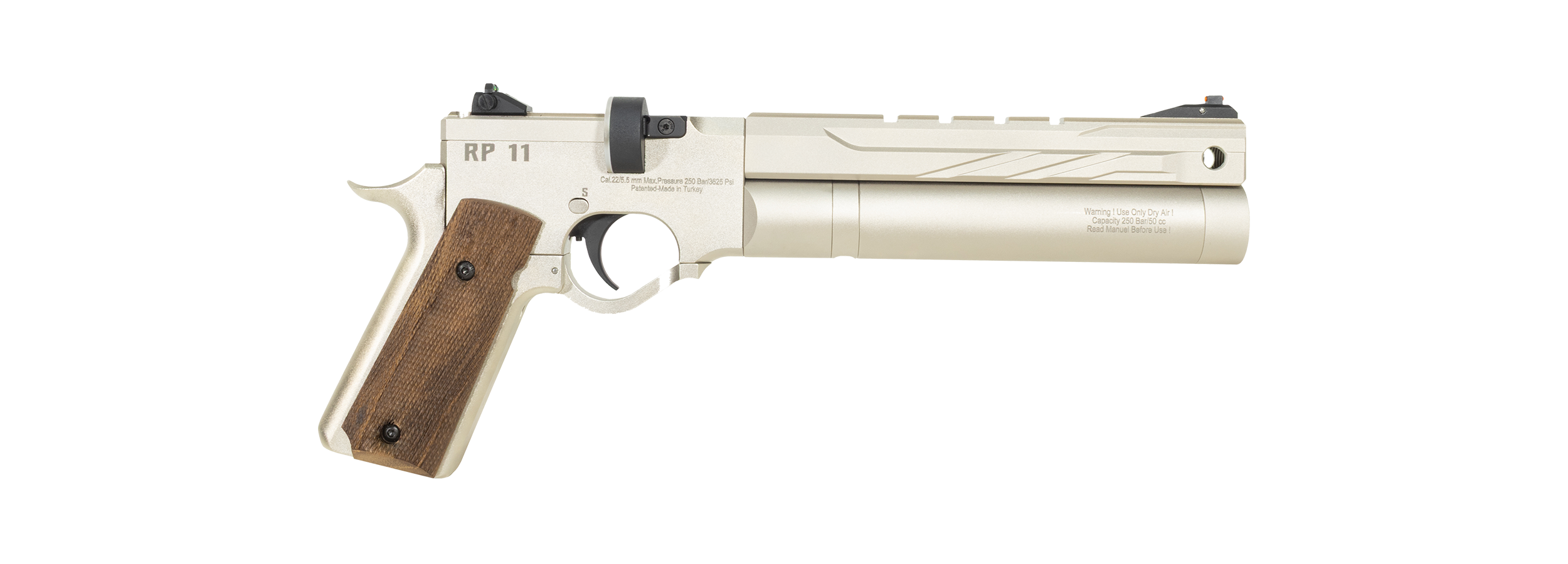
The Mito RP11 is the more overtly modern-looking of the two. With its aluminium 1911-style pistol grip and clean metal finish, it leans towards a tactical, industrial aesthetic that will immediately appeal to shooters who like a contemporary feel.
In the hand
At 1005 grams, the RP11 is the heavier of the two pistols — and that weight is noticeable, but not in a negative way. It gives the pistol a planted, reassuring feel, especially when shooting offhand. The aluminium grip adds rigidity and a sense of durability, and the balance feels neutral rather than front-heavy.
For shooters coming from firearm-style pistols or heavier air pistols, the RP11 often feels instantly familiar.
On the range
In .177, the RP11 really shows its strengths. The extra mass helps settle the pistol between shots, and the regulated action delivers a consistent, flat trajectory that makes precision shooting straightforward at typical air pistol distances.
The side-lever cocking system is smooth and positive, feeding from a 9-shot magazine in .177 (7-shot in .22). There’s nothing flimsy or toy-like here — the action feels deliberate and well put together.
Who is the RP11 for?
The RP11 suits shooters who:
Prefer a modern, tactical aesthetic
Like a pistol with a bit of heft and stability
Want something that feels robust and purposeful
Enjoy structured practice sessions and precision shooting
It’s a pistol that rewards control and consistency, and it feels built for regular use rather than occasional novelty.
Reximex Mito RP Race – Lightweight, Balanced, Sporty
The Mito RP Race takes the same mechanical platform and shifts the emphasis toward balance, weight reduction, and competition-inspired ergonomics.
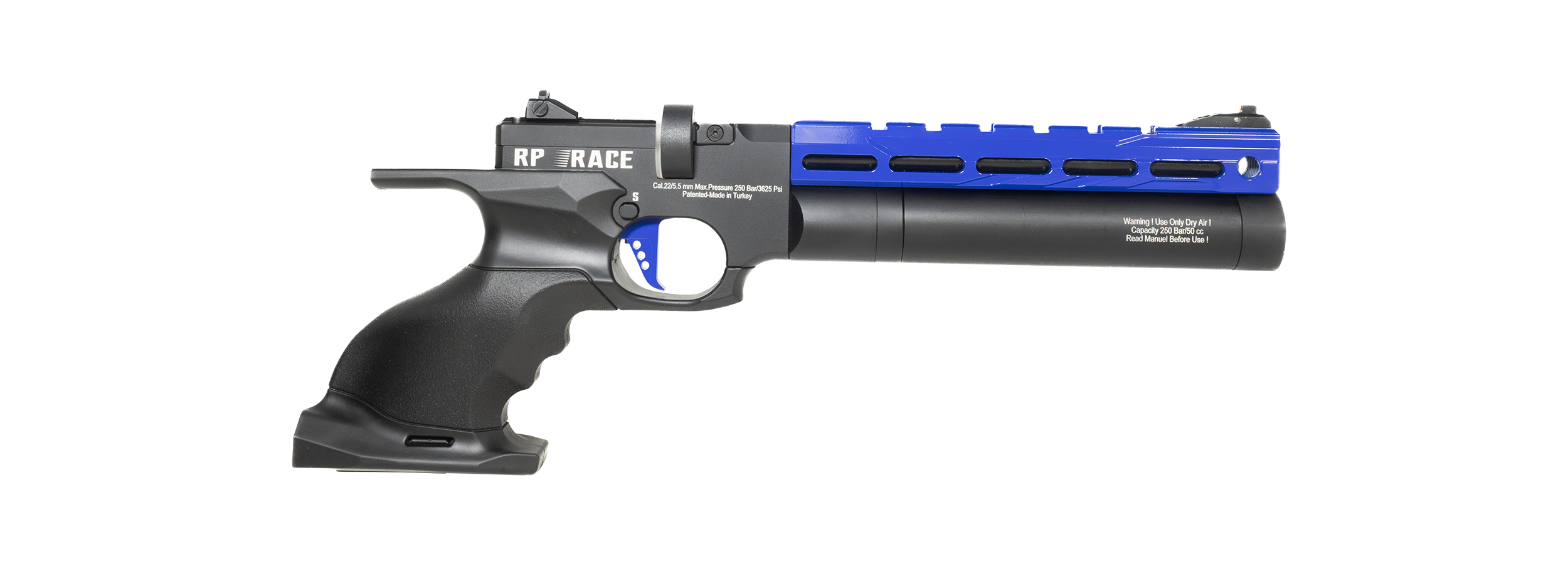
Visually, it stands apart thanks to its synthetic grip paired with a walnut stock — a combination that gives it a distinctive, almost hybrid look: modern but with a nod to traditional sporting design.
In the hand
At just 900 grams, the RP Race is noticeably lighter than the RP11. That difference doesn’t sound huge on paper, but in use it’s immediately apparent.
The pistol feels:
Faster to bring on target
Easier to hold for extended sessions
Less fatiguing during long practice runs
The grip shape and materials offer excellent control without feeling bulky, and the balance encourages a relaxed shooting style rather than forcing you to fight the weight.
On the range
The lighter build doesn’t mean reduced performance. The factory-fitted regulator ensures the same consistent delivery as the RP11, and accuracy remains excellent in both calibres.
In .22, the RP Race is particularly pleasant to shoot. The calibre’s naturally calmer firing cycle pairs well with the lighter frame, making the pistol feel smooth and forgiving — ideal for relaxed plinking or informal target work.
Who is the RP Race for?
The RP Race is ideal for shooters who:
Prioritise light weight and comfort
Shoot for longer periods
Prefer a more sporting or competition-inspired feel
Want a pistol that feels agile and responsive
It’s the Mito for shooters who value handling above outright mass.
.177 vs .22 – Does Calibre Change the Choice?
Both pistols are available in .177 and .22, and calibre choice can influence which model feels like the better fit.
.177 calibre offers a faster, flatter pellet trajectory and is often preferred for precision target shooting.
.22 calibre delivers a slower, more stable pellet that can feel more forgiving at close range.
In practice:
Shooters choosing .177 often gravitate toward the RP11, where the extra weight complements the calibre’s snappier feel.
Shooters choosing .22 often enjoy the RP Race, where the lighter frame and smoother firing cycle work beautifully together.
That said, both combinations work well — this is about preference, not limitation.
RP11 vs RP Race – Side-by-Side Summary
Choose the RP11 if you want:
A more modern, tactical look
Aluminium 1911-style grip ergonomics
A slightly heavier, more planted shooting feel
A pistol that feels robust and purposeful
Choose the RP Race if you want:
A lighter, more agile pistol
Reduced fatigue during long sessions
A sportier, competition-inspired aesthetic
A blend of modern materials with classic walnut
Both offer:
Regulated PCP performance
Side-lever operation
Compact dimensions
UK-legal sub-6 ft/lb compliance
Excellent consistency for their size
Final Thoughts: Two Flavours of the Same Strength
The Reximex Mito RP11 and RP Race aren’t competitors — they’re two expressions of the same capable platform.
The RP11 feels solid, modern, and confidence-inspiring. The RP Race feels light, balanced, and refined.
Neither is objectively “better”. The right choice depends on how you shoot, how long you shoot for, and what feels right in your hand.
At Pellpax, we’ve seen both models appeal to different types of shooters — and that’s exactly how it should be. Whichever Mito you choose, you’re getting a compact PCP air pistol that delivers real performance, not just clever design.
The Glock 17 holds a unique place in firearms history. Its design looks simple, but that simplicity reshaped expectations for pistols worldwide. In the early 1980s, Austrian engineer Gaston Glock and his team designed a modern service handgun for the Austrian military. They combined a polymer frame, striker-fired action, high-capacity magazine, and simplified safety system. This design was reliable, easy to maintain, and economical to produce. Glock won the military trials, and the pistol quickly became a global standard for law enforcement and military forces.
Glock Innovation: Materials, Mechanics, and Safety
Gaston Glock used his background in polymers and tooling to rethink pistol design. He replaced traditional gunsmithing techniques with modern materials and mass-production methods. The Safe Action system consists of three passive safeties that disengage only when the trigger is pressed. This allows faster deployment while reducing accidental discharges. Historians and enthusiasts can trace how early-production Glocks evolved over generations and influenced training and markets around the world.
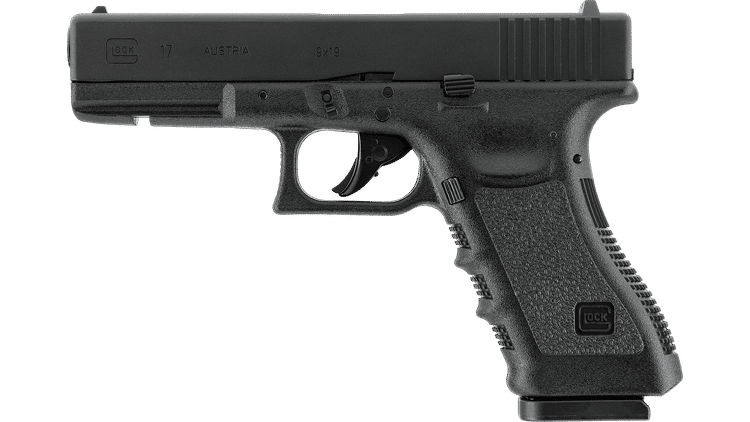
Glock 17 Air Pistol
Umarex and the Licensed Glock Replicas
As Glock pistols became popular, collectors, trainers, and hobbyists wanted safe, legal replicas. Umarex, a German company founded in the 1970s, recognized the opportunity. In 2017, they secured a worldwide license to produce officially branded Glock airguns and airsoft replicas. For the first time, the exact Glock silhouette and markings could be reproduced in a UK-legal airgun. This partnership demonstrates how a military-grade design can migrate into civilian culture through authorized reproduction.
Umarex Glock Models: Generations and Features
Umarex offers multiple generations of Glock replicas, covering both full-size and compact models.
Gen 4 CO₂ Glock 17
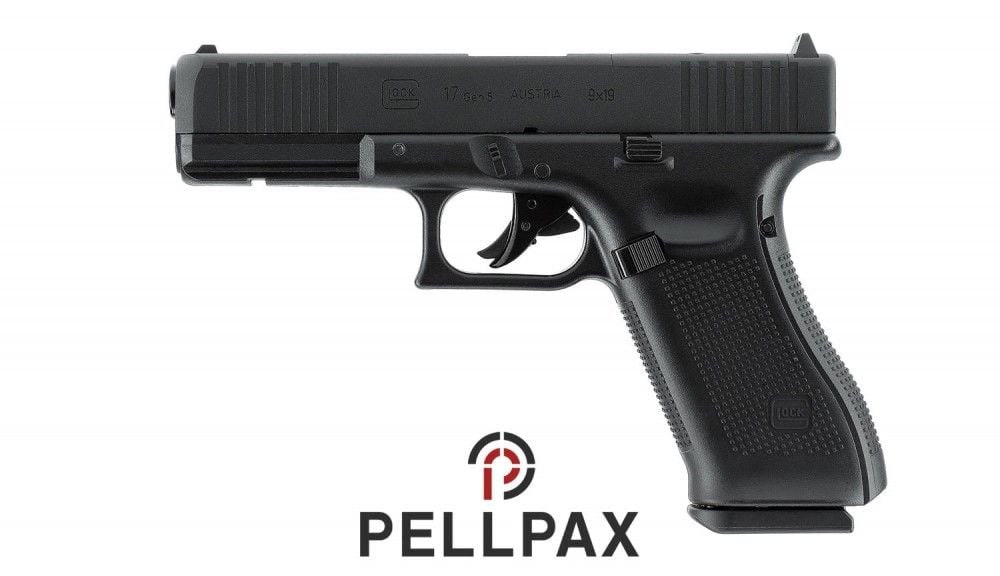
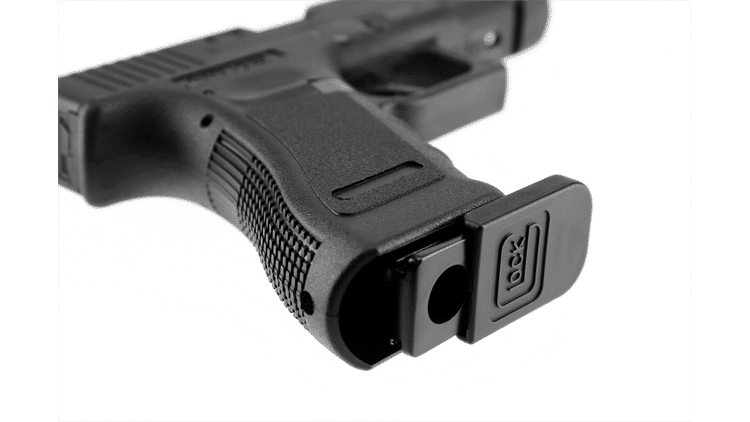
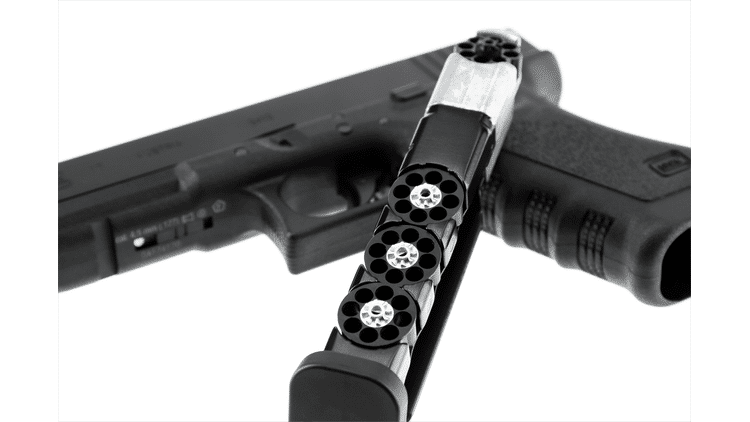
The Gen 4-style Umarex Glock 17 features a textured grip and replaceable backstraps. It fires 4.5 mm steel BBs using a CO₂-powered magazine. The blowback action produces a realistic slide cycle. Each 12 g CO₂ capsule typically provides dozens of shots.
Gen 5 MOS CO₂ Glock 17
The Gen 5 MOS replicas include optics-ready slides with adapter plates for red-dot sights. They mirror the real pistol’s ergonomics, slide design, and grip features. Some models also deliver slightly higher BB velocity, offering a more dynamic shooting experience.
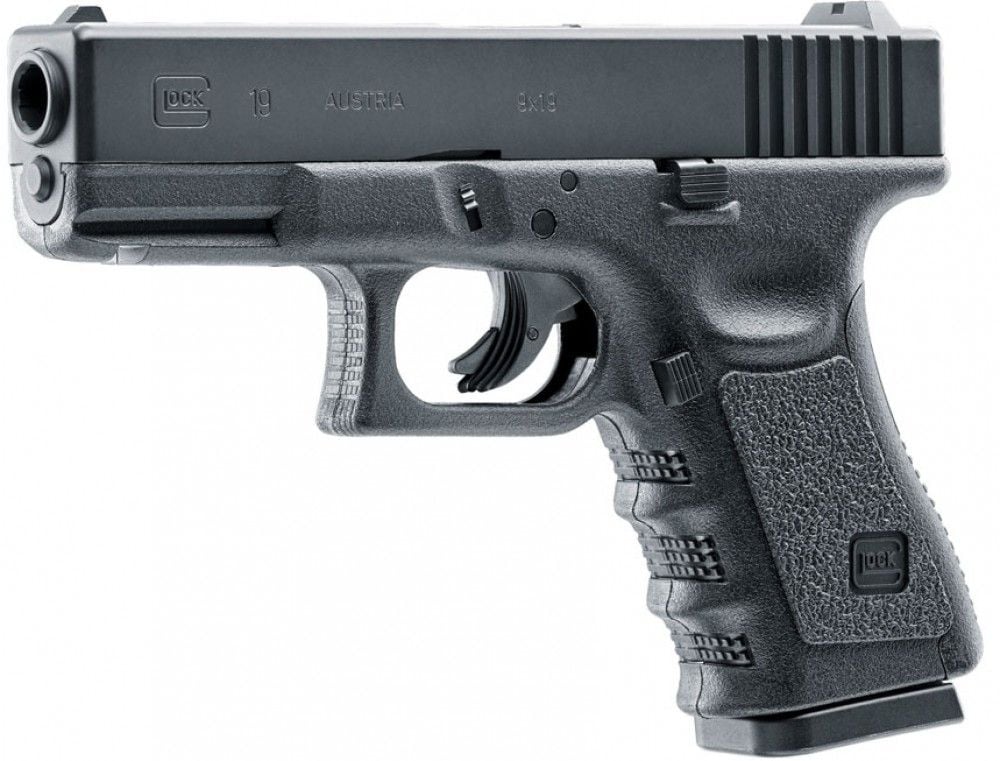
Glock 19 Compact Replicas
Umarex also produces Glock 19 replicas, a shorter, more concealable sibling of the Glock 17. These models retain realistic ergonomics and slide action, allowing collectors and trainers to enjoy the same feel in a compact frame.
Glock 19 Air Pistol Replica
Replica vs. Real Firearm
While Umarex CO₂ blowback pistols simulate the look and handling of a real Glock, they remain pneumatic replicas. Blowback is powered by gas and springs, not the full energy of a 9×19mm round. Velocities and effective range are lower, but the pistols allow safe practice for reloads, draws, and sight alignment. Collectors value the licensed markings, generation-specific details, and authentic silhouettes as cultural artifacts that capture Glock’s legacy.
Choosing the Right Replica
Before purchasing, decide what you want from a replica. Study the differences between generations — for example, Gen 4 finger grooves versus Gen 5 MOS features. Choose a CO₂ blowback model if realistic handling is your priority. Opt for pellet-compatible variants if accuracy matters at short range. Always follow UK laws, wear eye protection, and store air pistols safely. Umarex Glock replicas allow enthusiasts to interact with history in a tangible and safe way.
Conclusion
From Gaston Glock’s revolutionary design to Umarex’s licensed CO₂ replicas, the Glock 17’s story spans decades, continents, and cultures. Its influence extends beyond military and law enforcement use, reaching collectors, hobbyists, and trainers in the UK. Umarex’s Gen 4, Gen 5 MOS, and Glock 19 replicas offer a unique way to experience this iconic firearm safely, blending historical accuracy with recreational enjoyment.
More shots per fill, lighter handling and refined German engineering make the HW100 X one of the most compelling PCP upgrades in years.
Introduction: The Quiet Benchmark of UK PCPs
The Weihrauch HW100 has always occupied a slightly different place in the UK airgun world. It is not a rifle that ever needed to shout for attention. Instead, it built its reputation quietly, through consistency, longevity and a kind of mechanical honesty that serious shooters recognise immediately. For many, the HW100 became a benchmark PCP: dependable, accurate and engineered with a confidence that came from Weihrauch’s long experience rather than trend-chasing design.
With the arrival of the new HW100 X, Weihrauch haven’t attempted to reinvent that formula. Instead, they have focused on the one thing owners have been asking for over the years: more usable shots per fill, without compromising balance, handling or the unmistakable HW100 shooting feel. The result is a rifle that feels reassuringly familiar, yet noticeably improved in ways that matter to UK airgun enthusiasts.
The all new HW100X
Consistent Performance: The New Ultra-Efficient Regulator
At the heart of the HW100 X is its new ultra-efficient regulator, and it is here that most experienced shooters will immediately see the appeal. Regulators are nothing new in modern PCPs, but Weihrauch’s approach has always leaned toward reliability and long-term consistency rather than chasing headline numbers. The new regulator is fitted directly into the valve block and is easily accessible, which is a welcome detail for shooters who actually live with their rifles rather than treating them as sealed units. In use, it delivers a remarkably stable shot curve, translating to tighter spreads and a feeling of predictability shot after shot. Whether you are shooting from a bench, working through a Field Target lane, or taking careful follow-up shots in the field, that consistency is what builds confidence.
Cylinder Improvements: More Shots, Less Weight
That regulator works in tandem with the new 250 bar cylinder, and this is where the HW100 X genuinely steps into new territory. Made from high-grade aluminium, the cylinder not only increases fill pressure but also reduces overall weight. On the standard length rifle the reduction is around 360 grams, with the carbine shedding approximately 240 grams. Those numbers might not sound dramatic on paper, but in the hands the rifle feels subtly livelier, especially for shooters used to carrying an HW100 over longer sessions. Balance remains distinctly Weihrauch, slightly forward but reassuringly planted, while the reduced weight makes offhand shooting feel less fatiguing.
Of course, the headline benefit of the new cylinder is shot count, and Weihrauch have delivered in a way that feels genuinely useful rather than theoretical. In .177 calibre, the full-length HW100 X now offers up to 210 shots per fill, representing a roughly 90 percent increase over the previous model. In .22 calibre, the improvement is arguably even more striking, with up to 250 shots per fill, nearly an 80 percent increase. For UK shooters who value long sessions without breaking rhythm to refill, this is a significant upgrade.
Ergonomics and Stock Design: Comfort Meets Functionality
Weihrauch’s attention to refinement is also evident in the launch version of the HW100 X Sporter Laminate Adjustable. This model celebrates the evolution of the platform without drifting into unnecessary excess. The new laminate sporter stock is visually striking without being loud, and it retains the understated practicality that UK shooters tend to appreciate. The adjustable cheek-piece allows proper eye alignment with modern optics, which is increasingly important as scopes become more specialised. The new ventilated butt pad offers improved comfort and shoulder purchase, especially during longer shooting sessions, while remaining practical for field use.
One of the most welcome ergonomic updates is the inclusion of ambidextrous safety levers on both sides of the action. This is a small change with a big impact, particularly for left-handed shooters who have historically had to compromise or adapt. The HW100 has always been praised for its fast fire side lever action, and that remains unchanged in feel and reliability, but the improved safety layout makes the rifle more inclusive without altering its core character.
Adjustable laminate stock and cheekpiece
Modern Features: Accessory Ready and Field Friendly
Modern accessories are also better supported thanks to the integrated M-Lok rail system. This brings the HW100 X neatly into line with how many UK shooters now set up their rifles, whether for bipods, torches or other accessories, without forcing a tactical aesthetic. It is a practical addition that feels well judged rather than bolted on for the sake of fashion.
As expected from Weihrauch, the HW100 X arrives fully formed, without the sense that essential features have been held back for higher trim levels. The high-efficiency silencer is effective and well matched to the rifle’s power delivery, producing a subdued report that suits both range and field use in the UK. The quick-fill system is straightforward and reliable, while the two-stage match trigger remains one of the highlights of the platform. It is crisp, predictable and adjustable, offering the kind of control that rewards good technique rather than masking poor habits.
Who the HW100 X is For: Experienced Shooters and Newcomers Alike
What makes the HW100 X particularly appealing is that it feels like a rifle designed for people who already understand airguns. There is no attempt to overwhelm with gimmicks or exaggerated claims. Instead, Weihrauch have focused on measurable improvements that enhance day-to-day shooting. More shots, less weight, improved ergonomics and the same precision engineering that has defined the HW100 line for years. For existing HW100 owners, the X represents a compelling evolution rather than a replacement driven by novelty. For newcomers to the platform, it offers a mature, refined entry point into one of the most respected PCP designs available in the UK.
Accessory Rail under the Laminate stock
Versatility and UK Shooting Applications
From a UK perspective, the HW100 X fits comfortably into a wide range of shooting disciplines. Its consistency and shot count make it well suited to club shooting and competitions, while its reliability and handling continue to appeal to hunters who value equipment that simply works. The increased efficiency also makes it a sensible choice for shooters who want to minimise time spent filling cylinders and maximise time behind the scope.
At Pellpax, we see rifles like the HW100 X as long-term investments rather than impulse purchases. This is a platform designed to be owned, maintained and enjoyed for years, not replaced at the first sign of a new model cycle. If you are considering adding the Weihrauch HW100 X to your collection, or upgrading from an earlier HW100, you can find full details and availability on the Pellpax website, along with expert advice to help you choose the right configuration for your shooting.
Conclusion: Precision Refined, Not Reinvented
The HW100 X does not try to redefine what a PCP air rifle should be. Instead, it quietly refines an already proven design, listening to what shooters asked for and delivering it with the same precision and restraint that have made Weihrauch a trusted name in the UK. For many enthusiasts, that approach is exactly what makes this rifle so appealing.
Shooting airguns at night in the UK has never been easier thanks to modern night vision scopes. For sub-12ft lbs air rifles, spotting and accurately targeting rabbits, rats, and pigeons requires clarity, precision, and smart field techniques. In 2025, the top contenders are the Hikmicro Alpex A40, PARD Night Stalker Mini, and Pulsar Digisight Ultra N450. This guide compares them head-to-head and offers practical tips for ethical night shooting.
Why Night Vision Scopes Are Essential for UK Airgun Shooters
Night shooting with UK air rifles is increasingly popular for pest control, but darkness brings challenges: misjudged distances, poor target identification, and wasted shots. Using a dedicated night vision scope ensures:
Clear identification of quarry
Ethical shot placement at realistic ranges
Reduced disturbance of surrounding wildlife
For sub-12ft lbs airguns, most ethical shots fall within 30–40 yards, making a high-quality night vision scope essential for success.
Top Night Vision Scopes for UK Air Rifles in 2025
Hikmicro Alpex A40 – The 4K All-Rounder for Night Airgun Shooting
The Hikmicro Alpex A40 is widely considered the best night vision scope for UK air rifles in 2025. Its 4K CMOS sensor (3840×2160) delivers razor-sharp images, ideal for identifying rabbits in low-light conditions.
Why UK airgun shooters love it:
Magnification: 3.5x–20.5x lets you adjust precisely for sub-12ft lbs distances, ensuring ethical kills.
Fast one-second startup: Minimizes movement and keeps you undetected by wary rabbits.
Field of view: 18.7m at 100m is perfect for scanning fields and hedgerows.
Battery life: 7.5+ hours ensures long night sessions without interruptions.
Pro tip: Use the Alpex’s green or yellow night modes to reduce eye strain, and pair with a low-power IR illuminator to enhance visibility without startling your quarry.
The Alpex from Hikmicro has been designed with airguns in mind.
PARD Night Stalker Mini – Compact and Powerful Night Vision
The PARD Night Stalker Mini offers 1440p clarity in a lightweight and compact design, making it ideal for UK air rifle shooters who prefer a nimble setup.
Key features for airgun use:
Optical magnification: 3x, paired with 2x digital zoom, is ideal for typical pest control ranges.
Picture-in-Picture mode: Zoom in for a precise shot while keeping track of surrounding movement.
Connectivity: Wi-Fi and HDMI support via PardVision 2 app allows recording and live monitoring.
Pro tip: Carry a spare 18650 battery — cold UK nights drain power faster than expected. Smooth, deliberate movements paired with the Night Stalker Mini’s quick start make spotting nocturnal pests much easier.
The Night Stalker Mini is a fantastically compact night vision scope.
Pulsar Digisight Ultra N450 – Proven Reliability for UK Airguns
The Pulsar Digisight Ultra N450 is a trusted classic. Its 1280×720 HD sensor and frost-proof AMOLED display deliver reliable night vision performance, while its rugged design withstands the unpredictable UK weather.
Why it’s suitable for sub-12ft lbs airguns:
Magnification: 4.5x–18x covers most scenarios, with PiP mode helping target precision at ethical ranges.
Durability: IPX7 waterproof rating and robust housing make it ideal for damp conditions.
Stream Vision app: Allows pre-shoot practice and video recording of hunts.
The picture quality of the Pulsar Digisight Ultra N450 is fantastic
Pro tip: Swappable IPS5 battery packs ensure you won’t miss a shot due to power failure. Practice in daylight using PiP mode to familiarize yourself with reticle placement before heading out after dark.
The Pulsar Digisight Ultra N450 makes a great addition to any hunters arsenal.
How to Choose the Best Night Vision Scope for Your UK Air Rifle
When picking a night vision scope for UK air rifles, consider:
Magnification & field of view: Lower zoom is often better for sub-12ft lbs rifles.
Durability: Waterproof and shockproof units last longer.
Size & weight: Compact scopes are easier to handle on smaller air rifles.
Extra features: PiP, digital zoom, IR compatibility, and app support can enhance performance.
Conclusion: The Best Night Vision Scopes for Airgun Shooting in 2025
Hikmicro Alpex A40: Best overall — unmatched clarity, long battery life, and versatile features.
PARD Night Stalker Mini: Best compact option — lightweight, nimble, and ideal for barns or sheds.
Pulsar Digisight Ultra N450: Best proven reliability — rugged, weatherproof, and dependable for years but much more expensive than the other 2.
For UK airgun shooters, success at night isn’t just about tech. It’s also about ethical ranges, smooth movements, proper use of IR illumination, and knowing your quarry. Pair the right night vision scope with these practices, and 2025 will be your year for mastering airgun shooting after dark.
Published by Pellpax | Airgun Advice | 10 min read
If you’re new to airgunning or thinking about trying a different calibre, it can be confusing to know where to start. With so many options — from .177 to .30 calibre and beyond — which one is right for your shooting style?
In this guide, we’ll break down the key differences between the most popular UK airgun calibres, focusing on sub-12 ft/lb air rifles (no licence required), while also touching on higher-powered FAC airguns where relevant.
Whether you’re into pest control, plinking, or competitive target shooting, here’s what you need to know.
What Does “Calibre” Mean in Airguns?
In simple terms, calibre refers to the diameter of the pellet your airgun fires. It’s usually measured in inches, but often shown with a metric equivalent too (e.g. .177 = 4.5mm).
Different calibres behave differently in terms of:
Trajectory (how flat the pellet flies)
Velocity
Energy
Wind resistance
Stopping power
Understanding these traits is key to choosing the right tool for the job — especially within the 12 ft/lb power limit for UK air rifles that don’t require a Firearm Certificate (FAC).
.177 Calibre (4.5mm) – Fast and Flat
Ideal for: Target shooting, HFT/FT, plinking, light pest control Typical pellet weight: 7–10 grains
.177 is the most popular airgun calibre in the UK — and for good reason. At sub-12 ft/lb, it delivers high velocity and a very flat trajectory, making it perfect for shooting over varied distances with minimal adjustment.
It’s the standard choice for:
Field Target (FT) and Hunter Field Target (HFT)
Back garden plinking
Pest control on small quarry (e.g. pigeons, rats)
Pros:
Flattest trajectory = easier range estimation
Lower recoil and air usage
Wide pellet availability and choice
Cons:
Lower terminal energy
More affected by wind drift
Can over-penetrate on close-range pests
Tip: If you’re new to airgunning, .177 is a great place to start — especially if precision is your priority.
.22 Calibre (5.5mm) – Hard-Hitting Classic
Ideal for: Hunting, pest control, all-round use Typical pellet weight: 14–18 grains
.22 is the traditional hunter’s calibre — delivering more weight and stopping power on impact. While the trajectory is more curved than .177, it hits harder, making it a great choice for:
Rabbits and squirrels
Close- to mid-range pest control
Garden shooting (within your backstop)
Pros:
Excellent stopping power at sub-12 ft/lb
Better resistance to wind than .177
Less risk of over-penetration
Cons:
Requires more holdover at distance
Slower velocity can make rangefinding trickier
Tip: Practice at different ranges so you’re confident compensating for pellet drop.
.20 sits neatly between .177 and .22, aiming to offer the trajectory of a .177 with the impact of a .22. While not as widely used in the UK, it’s a favourite among enthusiasts looking for versatility.
It’s a strong performer in both target shooting and pest control, provided you can source quality pellets.
Pros:
Balanced flight and energy
Great all-rounder
Reduced wind drift compared to .177
Cons:
Limited pellet choice
Fewer rifles available in this calibre
Tip: If you find a gun that groups well with .20 pellets, it can be a real gem — just stock up when you find good ammo.
.25 Calibre (6.35mm) – Big Impact, Short Range
Ideal for: Close-range pest control, FAC rifles Typical pellet weight (sub-12): 19–27 grains
At sub-12 ft/lb, .25 calibre is a niche choice. The pellets are heavy and slow, which means a very arched trajectory and limited range — usually no more than 25–30 yards. However, the knockdown power at short range is excellent.
In high-power (FAC) air rifles, .25 comes into its own with devastating energy.
Pros:
Heavy impact, even at low power
Ideal for barn pest control (rats, pigeons)
Fun for reactive targets
Cons:
Very loopy trajectory
Poor accuracy at distance
High pellet cost
Tip: Only consider .25 for sub-12 guns if your shooting is exclusively at close range.
.30 Calibre (7.62mm) & Beyond – FAC Only
Ideal for: FAC hunting, specialist shooting Typical pellet weight: 44–50+ grains Power required: 50–100+ ft/lb
.30 and larger calibres aren’t viable for sub-12 setups. The pellets are simply too heavy to fly effectively at such low power. However, in FAC-rated rifles, these big bores are capable of taking out larger quarry at range with tremendous energy.
Expect serious noise, recoil, and air usage — but also serious impact.
Pros (FAC only):
Massive stopping power
Excellent wind-bucking ability
Great for larger quarry (where legal)
Cons:
Requires Firearm Certificate
Very expensive ammo
Not legal for general airgun use
Tip: If you’re considering .30, you’ll need an FAC and a good reason — this calibre is serious business.
Calibre Comparison Chart
Calibre
Trajectory (Sub-12)
Energy on Impact
Wind Resistance
Use Case
.177
Flattest
Light
Poor
Target, plinking, light pests
.20
Balanced
Moderate
Good
All-round use
.22
Curved
Strong
Better
Hunting/pest control
.25
Very curved
Strong (close)
Excellent
Close-range only
.30+
Not suitable
Massive (FAC)
Excellent
FAC hunting
Calibre vs Power: Making the Most of Sub-12 ft/lb
When you’re working within the UK’s legal limit of 12 ft/lb, calibre choice really matters. Since energy is capped, you’re always trading off between speed (trajectory) and weight (impact).
Smaller calibres = faster, flatter shooting, less energy
Larger calibres = slower, more powerful hits, but loopy flight paths
Ultimately, it comes down to your shooting style and what you’re shooting at.
Final Thoughts: Which Calibre Should You Choose?
There’s no one-size-fits-all answer — but here’s a quick recap:
Go for .177 if you’re focused on accuracy, targets, or longer ranges
Choose .22 if you want more stopping power for pest control
Try .20 if you want a bit of both (and can find the pellets)
Use .25 only if your shots are always close-range
Consider .30+ only with an FAC and specific hunting needs
Need Help Choosing?
Here at Pellpax, our team of airgun experts are always happy to help you find the right setup — whether you’re new to the sport or looking to upgrade your gear. Drop us a message, call our team, or check out our full range of air rifles and ammunition online.
If you’re new to airguns and trying to find something that feels authentic, shoots reliably, and doesn’t break the bank, then the Glock 17 CO2 BB Air Pistol is a solid choice worth looking into. Whether you’re buying your first BB gun or want a fun way to practice handling and shooting techniques, this replica offers a really accessible and satisfying entry point into the hobby.
In this post, I’ll walk through what makes this air pistol special — especially if you’re a novice shooter — and help you decide whether it’s the right fit for your needs.
Why the Glock 17 CO2 Air Pistol Is a Great Beginner’s Choice
The Glock 17 is a legendary firearm — it’s been trusted by police, military, and civilians around the world for decades. The CO2-powered BB version is a licensed, full-scale replica that feels incredibly close to the real thing. If you’ve ever handled the original Glock, you’ll appreciate the details here.
But what’s nice about this model is that it’s not just a showpiece. It’s built for use. It gives you the experience of handling a Glock without needing a firearms license or heading to the range every weekend.
For beginners, that’s a big win. It’s simple, approachable, and just plain fun to shoot.
Realistic Design That Mirrors the Original
One of the best things about this air pistol is how closely it matches the look and feel of a real Glock 17. It has the same grip texture, slide profile, and trigger design. Even the Glock logos and markings are there — this is an officially licensed product.
If you’re a Glock owner looking for a training tool or a new shooter who wants to learn on a platform that translates well to actual firearms later on, this airgun is a smart choice. It’s a practical way to get familiar with the handling of a pistol without any of the stress or cost that comes with live ammunition.
Built with Blowback and a Heavy Slide
The slide on this BB pistol is metal, and the blowback action is a standout feature. Every time you fire, the slide moves backward with each shot, simulating recoil. That little bit of feedback makes a big difference in training and just adds to the overall enjoyment.
If you’ve never fired a blowback air pistol before, this is a good place to start. It’s not overwhelming, but it gives you a taste of what actual shooting feels like — more than enough for casual practice or backyard plinking.
Simple, All-in-One Magazine System
The magazine design is clever. It holds both your steel BBs (18 rounds) and the 12g CO2 cartridge in one piece. You just load it up, pop it in, and you’re ready to shoot. On a single CO2 cartridge, you can usually get around 120 shots, depending on temperature and pace of fire.
If you’re just starting out, you’ll appreciate how hassle-free this system is. No fumbling with separate gas and BB loaders — just load, insert, and shoot. It’s fast, simple, and efficient.
Performance That’s Solid and Fun
For a BB gun aimed at beginners and hobby shooters, this one shoots pretty well. It reaches speeds of up to 377 feet per second, which is great for short-range targets like cans, paper bulls-eyes, or steel traps. At five to ten meters, accuracy is solid. It’s not a competition pistol, but that’s not the point here.
If you’re practicing basic aiming, trigger control, or just having a casual target session in the backyard, it hits the mark — literally and figuratively.
A Safe, User-Friendly Pistol
Safety is baked into the design. This pistol uses an automatic trigger safety, which means the gun only fires when the trigger is deliberately pulled — no need for external switches or manual safeties. That keeps things simple for new users and reinforces safe handling practices.
The trigger is double-action, which means it’s consistent from shot to shot. And because there’s no external safety lever to forget or fumble with, you can focus on learning good habits like proper grip and muzzle awareness.
Quick Look at the Specs
Caliber: 4.5mm (.177) steel BB
Power Source: 12g CO₂ cartridge
Velocity: Up to 377 fps
Magazine: 18-round capacity, holds BBs and CO₂
Shot Count: Up to 120 per cartridge
Trigger: Double-action
Safety: Trigger safety (no manual switch)
Length: 205mm
Weight: 705g
Build: Polymer frame with a metal slide
It’s a well-balanced airgun — heavy enough to feel real in the hand, but not so bulky that it’s hard to manage.
Who Should Consider This Airgun?
This is a fantastic pick for:
New shooters who want a safe and realistic introduction to airguns
Glock fans who want a training pistol that mimics the real deal
Backyard plinkers who want a fun, reliable BB gun
Gift buyers looking for something cool, practical, and beginner-friendly
It’s one of the few CO2-powered BB pistols out there that checks all the boxes for both realism and ease of use. You don’t need any experience to get started with it, but even seasoned shooters will find it satisfying to shoot.
Final Thoughts
To sum it up, the Glock 17 CO2 BB Air Pistol is a great choice for anyone just starting out in airgunning or looking for a realistic, affordable training tool. It’s simple, sturdy, and fun — and it delivers a shooting experience that feels far more premium than its price tag suggests.
If you’ve been on the fence about getting your first airgun, or you’re looking for a way to sharpen your skills without heading to the range, this could be the perfect fit. It’s easy to use, satisfying to shoot, and gives you a taste of what real Glock handling feels like — without the noise or recoil of a firearm.
Few firearms in history have achieved the legendary status of the 1911 pistol. Designed by the iconic John Browning and adopted by the U.S. military in the early 20th century, the 1911 has stood the test of time through world wars, modern conflicts, and a thriving civilian market. Known for its power, reliability, and elegant simplicity, the 1911 is more than just a weapon—it’s a cultural icon and a symbol of American ingenuity. This article explores the full history of the 1911, from its origins and wartime service to its lasting legacy in military and civilian life.
John Browning (1855 – 1926) Inventor of the 1911.
Origins and Development
The story of the 1911 pistol begins in the late 1890s during a time of intense innovation and modernisation within the U.S. military. In a single decade, the U.S. adopted numerous new firearms, including various revolvers and the Krag–Jørgensen rifle series. However, as self-loading firearms began emerging, driven by advancements like Hiram S. Maxim’s recoil-based reloading principle, militaries worldwide took notice.
In 1899 and 1900, early self-loading pistol trials were conducted by the U.S. Army, testing designs from Mauser, Mannlicher, and Colt. The trials resulted in the limited adoption of the DWM Luger pistol chambered in 7.65mm. Yet, its inadequate stopping power in combat, especially against determined foes like the Moros in the Philippine–American War, prompted re-evaluation.
The .38 Long Colt, standard at the time, proved ineffective against these resilient adversaries. In response, the Army temporarily reverted to the more powerful .45 Colt single-action revolver. This reinforced the need for a new sidearm with greater stopping power, culminating in the 1904 Thompson-LaGarde tests. The results favoured a semi-automatic pistol in .45 calibre, leading to the pivotal 1906 trials.
Of the six entries submitted, three were eliminated early. Only Colt, Savage Arms, and DWM (Deutsche Waffen- und Munitionsfabriken) remained. DWM eventually withdrew, leaving Colt and Savage to battle it out. A series of rigorous field tests from 1907 to 1911 pushed both designs to their limits. During a key test in 1910, Colt’s entry, designed by the legendary John Browning, fired 6,000 rounds over two days without a single malfunction—while Savage’s pistol suffered 37 malfunctions. Colt’s design emerged victorious.
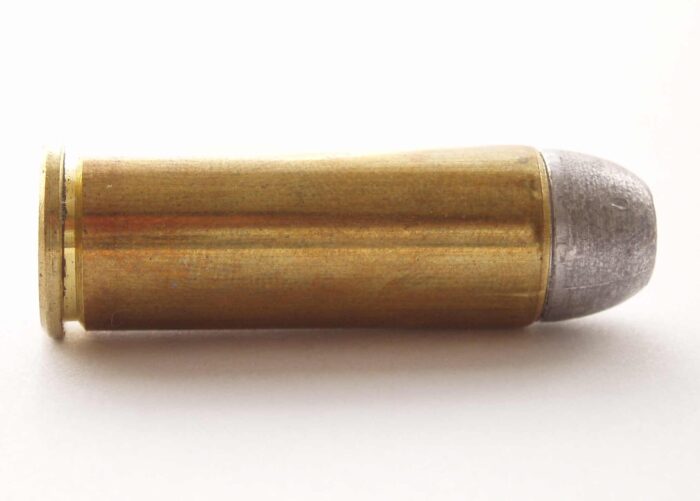
The .45 Colt round is often called the .45 Long Colt.
Official Adoption and Early Service
Following its stellar performance in trials, the Colt pistol was officially adopted by the U.S. Army on 29 March 1911, and designated the Model of 1911. In 1917, the name was simplified to Model 1911, and by the mid-1920s, it became widely known as the M1911. The U.S. Navy and Marine Corps formally adopted the pistol in 1913.
Early production models, including a limited number marked “N.R.A.” beneath the serial number, were distributed to members of the National Rifle Association by the Director of Civilian Marksmanship. The 1911 quickly proved its worth in real-world engagements, including during the 1916 Punitive Expedition against Pancho Villa. It officially replaced a variety of older revolvers and pistols, streamlining sidearm issuance across the military.
A labelled diagram of one of the early production models of the 1911
World Wars and Widespread Use
The 1911 pistol came of age during some of the most defining conflicts of the 20th century. Its performance in World War I and World War II helped cement its reputation as one of the most reliable and effective sidearms ever issued by a military force. Designed for rugged service and combat reliability, the 1911 adapted swiftly to the needs of a military expanding at an unprecedented rate.
World War I: Rapid Expansion and Contract Production
With the entry of the United States into World War I, the demand for small arms—including the newly adopted Model 1911 pistol—surged overnight. The U.S. military rapidly expanded its forces, and production at Colt and Springfield Armory, the original manufacturers, couldn’t keep up with the massive increase in orders. To meet wartime demand, production contracts were awarded to several additional companies.
Among those who successfully produced the 1911 pistol during WWI were Remington-UMC and North American Arms Co. of Quebec, the latter marking an important moment as one of the few Canadian firms contracted to manufacture the American sidearm. In anticipation of a long conflict, contracts were also issued to companies outside the traditional arms industry, including:
National Cash Register Company
Savage Arms
Caron Brothers Manufacturing of Montreal
Burroughs Adding Machine Company
Winchester Repeating Arms Company
Lanston Monotype Company
However, with the signing of the Armistice in 1918, the war came to an abrupt end before many of these companies could begin full-scale production. As a result, several of these contracts were cancelled before a single pistol had left their factories. Nonetheless, the expansion of M1911 production during this time marked a major shift, showing that even companies far removed from the arms industry could be mobilised during total war.
World War II: Peak Production and Standardisation
By the time World War II erupted, the 1911 had been refined into the M1911A1, incorporating user feedback from WWI. The pistol now featured an arched mainspring housing, shorter trigger, improved sights, and a longer grip safety spur—upgrades that enhanced ergonomics and ease of use in combat situations.
During the war, the M1911A1 was produced in staggering numbers. Approximately 1.9 million units were procured by the U.S. Government to equip soldiers, sailors, airmen, and marines across all theatres of combat. Once again, a wide array of manufacturers was brought into the fold to meet production targets. These included:
Manufacturer
Quantity Produced
Remington Rand
900,000
Colt
400,000
Ithaca Gun Company
400,000
Union Switch & Signal
50,000
Singer Sewing Machine Co.
500
The production of 1911 pistols during WWII also saw notable changes in materials and finish. To streamline manufacturing and improve corrosion resistance, the traditional blued finish was replaced with a parkerised coating, giving the pistols a matte grey-green appearance. Wooden grip panels were likewise swapped out for more durable brown plastic grips, which were easier and cheaper to mass-produce.
Among collectors today, 1911 pistols from this era are prized for their historical value. Of particular note are the Singer-produced M1911A1 pistols. With only 500 ever made, these models are considered the rarest and most collectible of the wartime variants. Even examples in poor condition command premium prices due to their extreme scarcity and unique provenance.
Throughout both world wars, the 1911 pistol became a trusted companion to American servicemen. Whether in the trenches of France or the jungles of the Pacific, the 1911 delivered the stopping power, dependability, and simplicity that soldiers needed in life-or-death situations. Its reputation, forged in the fires of global conflict, remains intact to this day.
A field stripped 1911 A1
Designation Changes
The pistol’s official designation evolved over time. Initially labelled as the Automatic Pistol, Calibre .45, M1911, it was updated to M1911A1 with the improved 1926 model. By the Vietnam War, it was referred to as the Pistol, Calibre .45, Automatic, M1911A1, reflecting a standardised naming convention within the U.S. military. These changes reflect both technological updates and the military’s evolving organisational structure.
Replacement and Continued Use
Though celebrated for its performance, by the late 1970s the M1911A1 was showing its age. Pressured by NATO standardisation efforts, the U.S. began searching for a 9mm replacement. The Joint Service Small Arms Programme led to the selection of the Beretta 92F, officially adopted on 14 January 1985, as the M9.
Still, the M1911 was never fully retired. Refurbished models continued to serve into the late 20th century, especially among special forces and elite units. Variants like the M45 MEU(SOC) and M45A1 CQBP reflect its enduring legacy within modern military service. Units like Marine Force Recon, Delta Force, and even FBI HRT have favoured updated M1911s for their reliability and precision.
Lasting Impact and Civilian Legacy
The legacy of the 1911 pistol extends well beyond the battlefield. For over a century, it has remained a favourite among civilian shooters, law enforcement, and military personnel. Thanks to its single-stack magazine and slim profile, the M1911 is popular for concealed carry and personal defence. Its reputation for reliability, straightforward mechanics, and robust .45 ACP chambering make it a top choice in self-defence and competitive shooting alike.
Civilian ownership of the M1911 is widespread in the United States. It is used in sport shooting disciplines such as the International Defensive Pistol Association (IDPA) and the International Practical Shooting Confederation (IPSC). Its historic appeal and customisable design have led to a wide array of manufacturers producing M1911-style pistols, including modernised and compact variants.
In a nod to its cultural and historical significance, the state of Utah declared the M1911 the official state firearm in 2011, honouring its designer John Browning, a Utah native. This symbolic gesture reflects the pistol’s deep roots in American innovation and identity.
Militarily, the M1911 served as the U.S. Armed Forces’ standard-issue sidearm from 1911 to 1985, seeing action in World War I, World War II, Korea, Vietnam, and even more recent operations like Desert Storm and Operation Iraqi Freedom. Its continued use by elite units like LAPD SWAT, FBI HRT, and special military units underscores its unique staying power.
In summary, the M1911 is more than a weapon—it’s a symbol of American resilience, ingenuity, and commitment to excellence in arms design. From the muddy trenches of France to modern shooting ranges and tactical units, the 1911 pistol remains as relevant and respected today as it was over a century ago.