Review: Clay Pigeon Shooting Training Day

If you’re interested in learning about using a shotgun, A great way to begin shooting is with a beginners course or some assisted training from an instructor. Our resident shooting journalist Hazel Randall tried out one such course, heading out for some instruction from Alan Evans of Fair Clay Targets.
Clay Pigeon Shooting. Credit: Dennis van Zuijlekom, 'Barrage'.
Clay Pigeon Shooting. Credit: Dennis van Zuijlekom, ‘Barrage’.

I arrived at my destination with a hammering heart and a sense of dread. My life-long fear of guns – including toy ones, which, pointed at my body, can induce in me a shameful hysteria – was kicking against the whole idea. As I shook hands with Alan Evans, of Fair Clay Targets, I put on what I hoped was a brave face.

Alan was just as I expected him to be – tall, friendly, and relaxed. My nerves subsided a little. He led me to a wooden table, where a double-barrelled, over-&-under 12-bore shotgun lay open. Alan showed me that there was no cartridge in the opened barrel. He put one into the chamber, and then he took it out again.

Having established that there was no ammunition in the gun, and that death was not imminent, Alan closed the barrel and got me to hold the gun. He showed me how to tuck the stock (I’d always called it the ‘handle’) into my right armpit, support the fore-end with my left hand, and push the lever with my right thumb to open the barrel. I then closed the barrel. I did this a few times, growing a little more comfortable.

Holding the gun

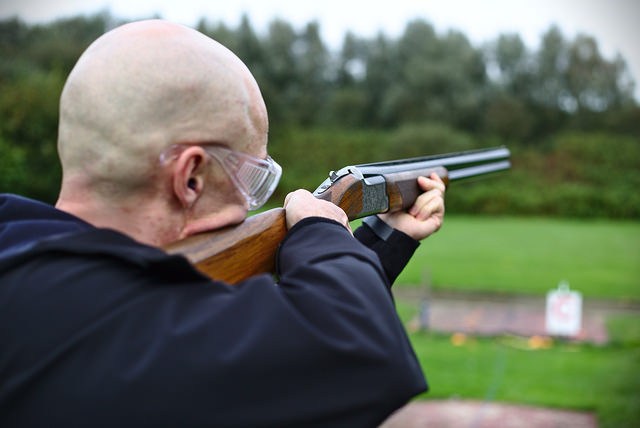
The next step was to learn how to hold the gun. I was shown how to push the butt into my right shoulder, supporting the fore-end with my left hand. Throughout the session, I made the mistake of positioning my hand too far forward, restricting the movement of the barrel when aiming. With right hand on the grip, forefinger on the trigger, and cheek nestled into position directly over my left foot, I stood side-on to my ‘target’ (Alan’s right eye). Cross-eyed and a little shaky, I tried to position the tiny white sight at the end of the barrel over my target. I was glad when that bit was over.

My heart rate rose again when we went over to the cage from which I was to shoot. Immediately in front of it, a rope ran the width of the field. I was told to stay behind the rope. Alan operated the trap from where we stood, pulling a couple of clays so that I knew what to expect. These clays, flying onto a background of trees, were bright orange, showing up well against the dark backdrop. The trap from the other end of the field fired black clays towards us; these were easily seen against the sky. Alan told me that the clays were biodegradable, and the debris was left where it fell, to decompose within a couple of weeks. I thought that was pretty marvellous. Alan gave me some ear protection to put on. It was time to shoot.

I opened the barrel, and Alan slipped a 24-gram shot cartridge into one of the chambers. Now the adrenalin was racing through my body. That first shot (which missed, obviously!) thrust the butt into my shoulder, and the bang filled my head. It was exhilarating. I liked the smell of the sizzling fumes that curled out of the chamber after the remains of the cartridge had popped out.

Following the clay

I found it difficult to follow the clays with my eyes and the barrel simultaneously, often holding the gun in a fixed position while my gaze wandered over the sky. Because my face was not hugged firmly into the barrel, my head tended to jerk backwards, throwing me off balance and the gun off target.

Thanks to Alan’s patience and expertise, my first experience of using a gun was an enjoyable one. The session ended with a strong, sweet cup of coffee and a biscuit, and the day ended with an almighty headache!

For more details of other approved courses nationwide, head to the BASC website. And check out our range of shotguns for sale, including pump action shotguns, and shotgun accessories like ear defenders, and delivery across the UK.
How To Get Started With Clay Pigeon Shooting

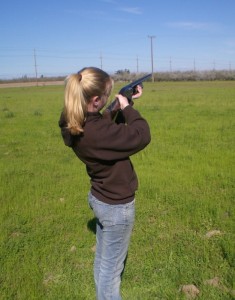
You don’t own a gun. You have never fired a gun. You have no gun licence. You don’t know how to obtain a licence. You don’t know if you need a licence. You don’t know anybody who shoots. So how do you get started with clay pigeon shooting?

Clay Pigeon Shooting. Credit: Dennis van Zuijlekom, 'Barrage'.
Clay Pigeon Shooting. Credit: Dennis van Zuijlekom, ‘Barrage’.

When you attend your introductory shooting lesson, you don’t need a licence or a gun of your own. Current legislation allows an unlicensed person to borrow a gun belonging to the occupier (not necessarily the owner, but a licensed person) of privately owned land, in his or her presence.

Do I need a licence?

However, it is a legal requirement that anybody who owns a shotgun must hold an up-to-date licence. A first shotgun licence, valid for five years and issued by the Firearms Licensing Unit of the local police force, can be obtained at a cost of £79.50 on completion of an application form (201) and a follow-up interview with a police officer. Form 201, application for a firearm and / or a shotgun licence, can be downloaded from various websites, including the BASC (British Association for Shooting and Conservation), Shooting UK (a popular UK shooting website), and your local police force’s website. A shotgun licence application can take months – or as little as three weeks; it depends on whereabouts in the country you live. We’ve written a detailed blog post on the topic here.

Where can I practise clay pigeon shooting?

trap clay pigeon shooting club
Clay Pigeon Trap Shooting can be found in local clubs around the country.

There are over 500 clay pigeon shooting clubs in the UK, including 11 in Norfolk. You can find your local club by heading over to the Clay Pigeon Shooting Association. Check out our site for all your shooting accessories. Contact a club near you and book yourself onto a clay pigeon shooter beginner’s session, where you will be coached in technique, gun safety, site safety … and jargon, of course!

As a beginner, you will use a gun with a fitted recoil pad. Recoil (also known as knockback, kickback or kick) is the backward momentum of the gun when it is discharged. Being of equal force to the projectile (plus any ejected gases), the recoil is, understandably, quite a shock for a first-time shooter. Recoil pads are made from a soft material, e.g. rubber or leather, and are attached to the buttstock of the gun or strapped onto the shooter’s shoulder, which also serves to prevent the gun from slipping on clothing.

And what about clothing and essential shooting supplies?

Wear comfortable, safe shoes. Wellington boots are ideal in wet weather, and in drier conditions, walking boots or trainers are suitable. Ensure that laces are securely tied. Well-fitting clothes are essential. Tight clothing will obviously restrict movement, but baggy clothing, too, is restrictive in its tendency to get in the way.

The wearing of adequate and effective eye protection by shooters and trappers is now mandatory. It’s possible to wear additional eye protection over the top of prescription glasses; however, many people find this physically uncomfortable and a visual hindrance. As glasses are considered ‘adequate and effective’ protection, people often choose to wear either their own glasses or special eye protection.

It is advisable to wear some form of hearing protection is also compulsory when clay pigeon shooting. A discharging gun is extremely loud, and eardrum damage is irreversible. Check out advice from the Clay Pigeon Shooting Association for more advice on the exact guidelines;

You can find the BASC website here to get your Form 201. Detailed instructions on how to apply for a certificate can be found here. And guidance from the Clay Pigeon Shooting Association is available here

If you already have your certificate, you can grab shooting supplies in our Shotgun store, and shooting accessories such as shotgun cartridges here.

And head to the Clay Pigeon Shooting Association, where you can find a club near you. 

Adventures In Airsoft: What Is MilSim?

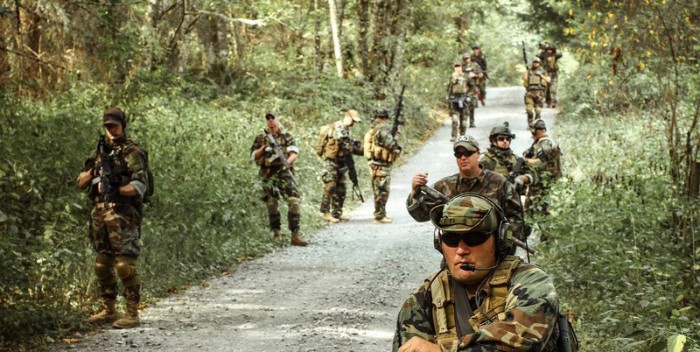
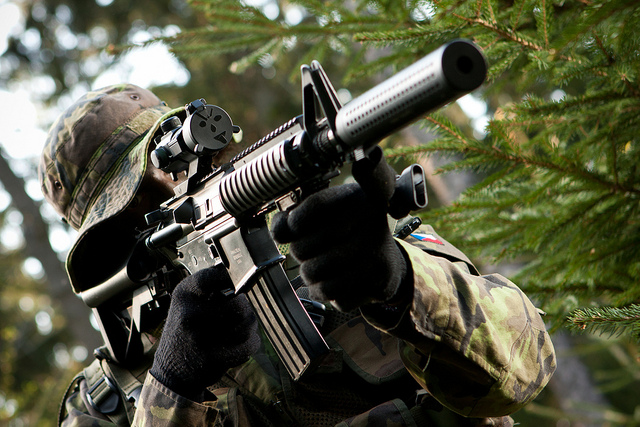
A Milsim squad out in action

One of the keys to practicing Airsoft is MilSim – the highly realistic military simulations that make for a typical weekend of airsofting. Here we explain the terminology, gear, and what you can expect….

Before we go straight into talking about MilSim we need to determine what it is and why it takes place. MilSim is an abbreviation for Military Simulation and it comes in 2 types: entertainment / war games or re-enactment. Out of the two, war games tend to be the more popular because they don’t require lots of expensive equipment or experience.

MilSim is becoming increasing popular in America and Europe with hundreds of people turning up to take part in the games. I’m not a professional myself, although I do have a love for airsoft, so I’ve decided to share the basics with you about what you need to know, if you decide to participate in any of these milsim uk events.

Time to Gear up!

Probably the most important thing about MilSim is the equipment. Although a lot of people go and spend hundreds of pounds on equipment, it is not necessary for your first time. The best way to approach it is to buy the basics first, and after each event decide what was good, and what held you back during the games. Once you’ve identified these areas of improvement, then you can buy the accessories accordingly and prevent these problems re-occurring.

With that sorted, let’s talk about the basic equipment. Before assembling your loadout, you need to sort out your uniform and one important thing to note are restrictions. You won’t get told off for not polishing your shoes or wearing the wrong belt, but the organizers often put restrictions on the type of camouflage each team can wear. This helps each team identify friend or foe, and generally adds realism to the game. Some events go even further and ask you to match your gun according to the teams, but for lower grade MilSim this is rare.

You Need Good Footwear for Milsim

Don’t underestimate the importance of good footwear. The boots are as important as your BB pellets. I would not recommend wearing uncomfortable boots, or new boots to a MilSim, since blisters are a sure way to halt your fun. Make sure you have a pair you’re familiar with, and happy to wear for long periods of time. Two pairs of good quality walking socks are also something I’d recommend and should see you though the Games.     

What you choose to carry is purely down to what military role you want to play. If we’re talking about an average rifleman, you will be carrying around 5-7 magazines (including the one in your gun), an easily accessible radio and water. Most players like to wield a sidearm, typically a pistol but this is entirely up to you. Most MilSim games don’t allow you to reload your mags until you’re at a respawn point so carrying spare BBs is pointless. Finally, grenades are used by a number of players, and generally are fun to use. Again, there is a restriction on how many you carry, which is normally around six, but it’s always best to check with the organizers first.

Your gun is your trusty companion during these few days. There are three types of airsoft guns which include electric (often known as AEG), gas and spring. Spring isn’t used as often since they tend to be weaker and therefore can’t get the range required. Electric and gas are used the most due to their range and power, so if you plan to use these, ensure you have spare batteries or gas cans packed.

How to survive the next few days

Since these events last a few days, you will be required to take all your equipment with you. This includes sleeping bags, roll mats, clothes, grenades, guns, maps/intel etc.

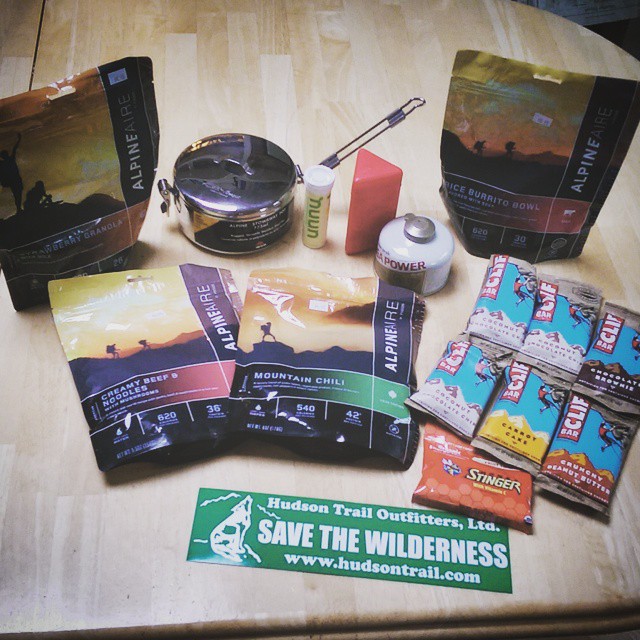
Survival In The Elements: With Essential Nutrients like Milsim Food

An accessory that I would call a very smart investment is a patrol pack. This is a smaller bag that you can take with you when advancing, resupplying or guarding areas. Within these you typically put the essentials such as water, food and cooking equipment. You can also pack some form of thermals in case of a sudden temperature change.

Water is absolutely essential in these events. It doesn’t matter if the weather is like an Australian summer or a Russian winter you will be using plenty of this stuff, so take it! You will need it for drinking, cooking meals, washing up and cooling off. I would highly recommend refilling your canteens / water bottle at any chance you get and make sure everyone in your squad takes some to reduce the load.

When you take part in Milsim your will be burning a lot of calories and will get hungry quicker than usual. The running around and carrying of equipment soon takes its toll, so it’s best to be prepared. Small cookers are very handy whether they are gas or fuel. It would be wise to find a compact one and take it with you on your MilSim experience. I also pack a mess tin and use it for eating, cooking and washing up. Most people tend to take food packs with them although other alternatives are available.

What to expect on your first MilSim

When you first go to a MilSim event a lot of things will go through your head beside adrenaline. You will be getting briefs, being put into squads (expect to be bossed around a lot by the pros), assignments/missions will be handed out and loads more. This is all part of the fun and realism of MilSim and when all combined it aids the excitement of the event, no matter if you’re a MilSim veteran or a private. Even though these events are very tactical and physically straining, everyone is friendly and there for the same reason – to have a good time! The war games will be played in different areas depending on their location and organizer. Some are based outdoors on large areas of land, some are indoors with built scene and the best sort, in my opinion, are the ones based in abandoned facilities. The main thing to expect is lots of fun, excitement and a whole new experience of war games.

When you first go you will be trying new things, trying to find your role, play style and figuring out what’s going on. This is completely normal for a first timer and isn’t anything to worry about. The more you play the more you’ll learn and find out about yourself. I soon discovered my love for sniping, playing that support / cover role and making key decisions for my team.

The more MilSim events you attend your more people you’ll get to know, more gear you’ll acquire and you’ll start to get a feel for what sort of player you are. The biggest thing I notice is the different paces of these war games. Sometimes you will be stealthy and tactical like a spec ops group or you may just go in all guns blazing. The main things to remember is to have fun, play fair and enjoy this experience of a whole new level of airsoft.     

To find a registered airsoft game site near you, check out this list published by UKARA, the British body in charge of the sport.

To check out our range of airsoft gear including accessories, simply head to our Airsoft store, where you can grab airsoft guns, glasses, batteries, silencers, targets, and much more.

Tips For Shooting At Night with Scopes & Lamping

When hunting at night there are a two main things which must always be considered and upheld at all times: safety and the law.   

deer hunting texas wikipedia
Deer hunting at night. Source: Wikipedia

Unless you can obtain a special licence to cull deer at night, it is illegal to do so between one hour after sunset and one hour before sunrise. Game birds and hares also cannot be shot at night. Night shooting is generally used for population control of pests and certain predators such as foxes. You must also only shoot on land that you either own, or have permission to shoot on; shooting on land without permission is a serious offence and comes with heavy fines and even a custodial sentence.

A Rifle Scope is Essential

Generally, at night time, I would always recommend using either rifles or air rifles with scopes on, so that you can more easily identify both your target and where the shot could go afterwards. You should also never just shoot at a pair of eyes, through a scope or otherwise, as what you think could be a pair of rabbit eyes could be a pet, or even someone with binoculars observing animals at night.

It’s also strongly recommended that when shooting at night, you use a suppressor, so as not to make too much noise, which could disturb people in local houses trying to sleep, and scare nearby livestock.

At Pellpax we stock a large range of suppressors for air-guns and rifles alike. Click here for more in air rifle silencers. And here for more on Rifle sound moderators.

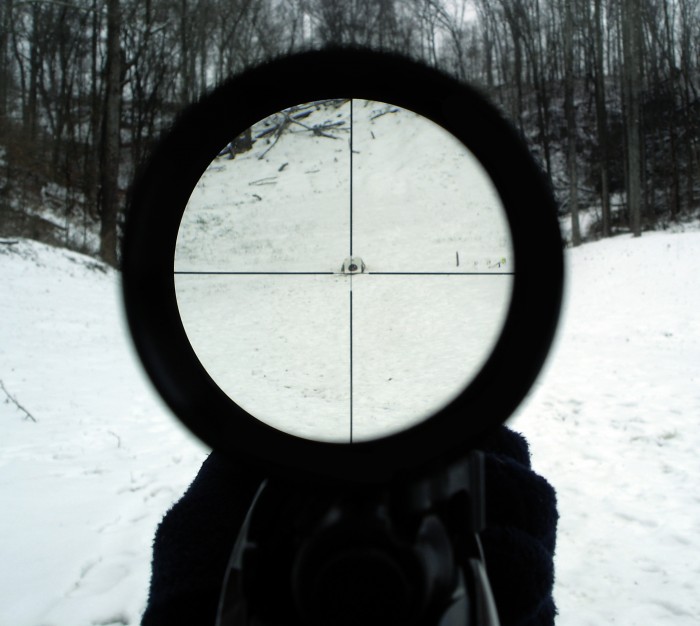
The view down a 4 x Scope

When shooting foxes, you must ensure that you’re using a calibre of rifle that is legal; generally, .22 Hornet or larger are favoured; air rifles and rim-fires are not legally permitted.


Using a scope at night can be hard work if your scope hasn’t got an IR (illuminated reticle), which is when your crosshair will clearly light up, making your point of aim much clearer. As well as this, you will also need a good spotlight or torch to identify your targets; a bright light also temporarily stuns animals such as rabbits, which will make for an easier shot. You should also choose a scope with a large light intake, which will make for a much clearer and wider field of view. For example, there’s the Hawke Vantage 3-9×50 IR Mil dot reticle scope, and the more powerful 4-12×50 version.

Three Lamping Colours

There are three most popular colours of bulb which are used when lamping or shooting at night, and they all have different pros and cons – all of which are down to personal preference: red, green, or white.

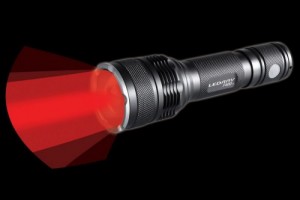
The most popular colour for lamping is a red bulb. This can commonly be seen when driving around back roads at night and you see farmers using these red spotlights across their fields, looking for rabbits or foxes. It’s a popular favourite because the red light doesn’t affect your personal night vision as much as the other colours, and animals are less aware of this bright light being put on them, and so won’t get spooked and run away. The red light can make it quite hard to spot your prey at night if they are in long grass or in the undergrowth, as everything will appear as the same colour. This is still the first choice for any fox or rabbit hunters. You can find a red spot light here – the Tracer LEDRay F400 Red.

The green spotlight is quickly becoming more popular because, like the red light, it has little effect on your own night vision, and with the green light, it’s much easier to identify different targets, because it shows up differently on obstacles – unlike the red, where everything can blur into the same colour. The green light, however, is a lot less popular with shooters after predatory animals like foxes, because they notice this colour a lot more and have been known to run away as soon as the beam is on them. A great example is this, the Tracer LEDRay F400 in Green.

F400 Red Lamp
F400 LED Red Rifle Lamp


Finally, we have the white spot light. This offers the greatest distance for you to shoot at, and makes everything a lot easier to see at night, but it will have the worst effect on your own night vision and will scare predatory animals away the most. However, this is my personal favourite to use when shooting rabbits, as the bright light stuns them for a moment, allowing for a clear shot and clean kill. One white light to try is the Tracer LEDRay F400 in White.

All of the above spotlights, which I have added the links to, are for attaching either onto the gun, or onto the scope – which would be my personal preference when shooting. There are other options available, however, depending on the environment and style in which you will be shooting, such as from a vehicle or with another shooter.

Night Vision Scopes

Another option for night shooting is the use of a night-vision scope. Originally intended for military applications, this is another favourite among hunters, as these night sights are becoming ever more affordable for the everyday shooter.

Check out a range of gun lamps and spotlight options here.  You can also check out our website for more on night vision, including gear by Nitesite and Pulsar. 

How Can I Get A Shotgun Licence?

You may be tempted by the impressive array of shotguns we sell here at Pellpax. Unlike many shotgun retailers online, we can deliver them direct to your door. However, you will need a licence, as it’s a requirement of law here in the UK. We take a look at how you go about acquiring a shotgun certificate here.

A Licence is Essential

A shotgun, under section 1(3) a of the Firearms Act 1968 (as amended), is defined as a smooth bore gun (not being an air weapon); having a bore less than 5.08 cm and a barrel not less than 60.96 Shotguns on Wallcm; having either no magazine or a non-detachable magazine incapable of holding more than two cartridges; and not a revolver gun.

It is a legal requirement that anybody who owns a shotgun or buys a shotgun for sale, must hold an up-to-date licence. A first shotgun licence, valid for five years and issued by the Firearms Licensing Unit of the local police force, can be obtained at a cost of £79.50 on completion of an application form (201) and a follow-up interview with a police officer.

Form 201, application for a firearm and / or a shotgun licence, can be downloaded from various websites, including the BASC (British Association for Shooting and Conservation), and your local police force’s website.

Security & Vital Info

It is good practice to arrange security immediately, ensuring that your locking cabinet, or alternative storage, complies with safety regulations. The application form includes questions about the provision of storage and security – proposed or in place – and the visiting police officer will need to be satisfied that your arrangements are appropriate; the application process can be slowed down by a lack of adequate security measures in place.

When completing form 201, you will be asked to give personal information regarding contact details, previous names and addresses, place and date of birth, nationality, convictions, and place of work. There is a section concerning personal health. It is a legal requirement that the applicant discloses all physical and mental health issues, both current and historical, and the signing of the form gives the police permission to contact the GP in order to verify the information given.

Any person who has known you for at least two years may act as a referee. The referee’s personal details (full name, date of birth, occupation etc) and contact details must be provided, along with four passport-style photographs of the applicant – one of which must be signed by the applicant.

The Next Stage

After four to six weeks, you will receive notification about your application. If this first stage has been successful, a police officer will visit you at your home to discuss safety arrangements – proposed or in place – and your reasons for owning a shotgun. It is perfectly reasonable to say that you want to take part in shooting for sport.

If the officer is satisfied with your security instalment, he will notify the Chief Officer of Police, and your certificate will be issued. If everything else is satisfactory, but your provision for safe storage is not yet in place, your certificate will be hand delivered by a police officer once he has seen, and is satisfied with, your gun security arrangements.

If successful, the certificate you will be issued with will last for 5 years. If you’re unsuccessful, you will receive a letter from the local Chief of Police, with the reason, and detail of the appeals procedure.

You can check out and buy a shotgun for sale from our online store right here. We sell shotgun accessories, too.

How to Take Care of Your Airgun

It’s important to take care of your air pistol or air rifle, in order to ensure that you get the most out of it.

An airgun is a precision instrument – a complex piece of machinery. Rough treatment will cause irreparable problems, shortening the active life of an airgun that should, in the best of circumstances, last for many decades.

air-arms-tx200-mkiii-beech-stock-22-rifle-length-3820 (1)
The Air Arms TX200 is a great example of a top of the range underlever airgun

When transporting an airgun, ensure that it is settled securely in your vehicle, protected from bumps, falls, and collisions with other objects. Parts of the airgun’s mechanism can be knocked out of alignment, and there are some parts, perfectly adequate for normal use, that will break under stress.

Cocking a break barrel airgun can take quite a lot of force, especially in modern models such as the Gamo Hunter 440 .22 and Hammerli .22, whose powerful locking mechanisms are built to contain intense pressure in the firing cylinder. But once the pellet is loaded, do not slam the barrel closed. If the locking mechanism is damaged, the barrel will be nudged out of position, and accuracy compromised.

When cocking an underlever airgun, like the Air Arms TX200, the lever must be pulled back as far as it will go, and only at the final stage will the safety button engage. If you stop pulling too soon, and attempt to close the lever, it will seem as if the lever is stuck. It is important not to force the lever back to the closed position, but to continue pulling the lever back into the cocked position.

It is advisable to wipe the bore of your airgun, after use, with a dry cotton flannel patch. This serves to remove particles of lead or any moisture. Never use solvents in the bore, because there is a danger of it getting into the valves and damaging the plastic or rubber materials of the valve seats.

bcsha-8822
To protect your airgun from damage, use Birchwood Casey Barricade Rust Protection

External metal surfaces should be treated with a thin film of Birchwood Casey Rust Protection, and wooden surfaces with a smear of oil.

When changing the cylinder on your CO2 gun, never over tighten the cylinders, for this can damage the threads. Brush dirt from the threads with a toothbrush and apply a very little synthetic grease to the threads every 20-30 times that you change the cylinder.

Lubrication is important. A dab of Crosman Pellgun Oil on the end of each new CO2 cylinder is sufficient to lubricate the seals that engage the neck of the cylinder. But beware of over lubricating – the gun’s mechanism can be clogged up and damaged by excessive grease.

Airguns seldom need dismantling for cleaning. They burn no powder and therefore produce no residue. They fire clean lead bullets at comparatively low velocity, and so only in the more powerful of airguns is there ever any metal fouling. An airgun can be fired tens of thousands of times between cleanings. If your airgun is being used infrequently, it won’t need a check and thorough clean more than once in six years. Those who shoot on a daily basis, however, should have their guns checked and cleaned annually.

First vital point in caring for your airgun: read the owner’s manual and follow the guidelines.

Second vital point in caring for your airgun: if a lever or button isn’t moving as easily as it should, don’t be tempted to force it. Find out what is preventing normal operation and fix that problem.

To check out our wide and growing range of Airguns, head over to the Pellpax Store

Six Awesome Shooting Tips for Your .22 Air Rifle

You’ve taken the plunge and gone out and finally bought that .22 air rifle for sale online, that you promised to yourself – ideally from us!

But now you’re in your backyard, plinking away at targets to discover that you’re not the natural gunslinger you’d assumed you would be. Have no fear. Shooting takes practice, and a little knowledge of technique can go a long way.

People testing out their air rifle target skills. Source: Wikipedia.

Here are some tips to help you on your journey to being a top shooter.

  • Use a decent air rifle scope: There is a huge world of difference between shooting using open sights, and any scope. This will increase accuracy by 50% at least. You may wish to challenge yourself by shooting using open sights, but in general, it’s best to use a scope if you want to hit the target. Look out for higher levels of magnification and spec if you’re serious, and have the budget.
  • Let the airgun point where it wants to: this may sound a little like ‘use the force, Luke’, but there is truth in it. By standing naturally with your airgun, holding it as you would normally, and then seeing where it points, you will find it naturally points in a certain direction. By adjusting your body accordingly like you and the gun are part of one big mechanism, you will be far more likely to hit the target than if you try to move your arms around to zoom in your quarry.
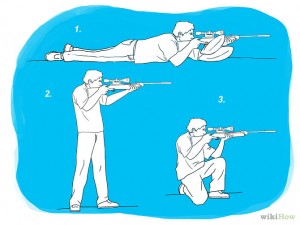
  • Shoot From The Prone Position: The easiest way to learn how to shoot accurately is to lie down on your front, with the rifle resting naturally in your hands. It’s known as the ‘prone’ position, and is a good way to develop your accuracy. Not to be dismissed, you can always use it as a building block to grow your shooting style, before you learn to shoot on your feet.
  • Use a Rifle Sling, Bipod or Tripod: If you’re shooting from the upright position, then a rifle sling can help you to carry the weight of the rifle more comfortably, leaving your hands to focus in on fine tuning your aim. Equally, if you’re down on the ground, a bipod or tripod attachment can take the load off your hands, and let you dedicate your energies to finding the sweet spot.
  • Relax: Tension, in the mind, body, or both, is going to ruin your aim. By relaxing the body and mind as much as possible, particularly with deep breaths before, and after the shot, you can keep your arms nice and loose, and zone in on what you’re trying to hit.
  • Spread your Shots: When aiming at a target, if you constantly try to hit the centre of the circle, you will find you quickly create a hole which makes it difficult to discern whether you’re hitting subsequent shots correctly or not. By aiming at different points on the target board, you will distribute them more evenly, and be able to see whether you’re hit what you were aiming for, more easily.

So there you go. Happy shooting, and if you need help, advice or more gear, be sure to get in touch, or check out our site for .22 air rifles for sale, and shooting accessories including Scopes, Slings, Bipods and Tripods, to help with your endeavours! 

Airsoft 101

Here at Pellpax, you may be an airgun or outdoor enthusiast, and noticed our Airsoft store. We have a range of airsoft pistols, and airsoft rifles for sale, as well as accessories. So it seems only fitting that we provide you with this introduction to airsoft, which could turn out to be your favourite new sport.

What is Airsoft?

You may have heard of airsoft, seen the guns and name of the sport around online, and wonder what’s all about. It’s essentially a team sport between two groups where they do battle with specially 4618103657_4ebd3ae60c_zdesigned guns which fire non metallic, spherical ball bearings / pellets. Unlike paintball, for example, these projectiles do not leave a mark, and so the sport of airsoft relies on the honesty of the participants to self report when they have been struck.

Origins

The sport of Airsoft hails originally from Japan, where manufacturers Tokyo Marui famously produced the AEG (automatic electric gun), which they sell to this day. They would vend the gun in parts, and leave it to the customer to assemble them, with a focus on creating weapons with an ultra-realistic look which is still central to airsoft today. The majority of airsoft rifles and airsoft pistols are today made in Asia, and their true-to-life look means they are often used by police officers to assist with training.

Ballistics & Safety

Different weapons powered by different power plants (AEG, gas powered, spring powered, etc), will cause airsoft pellets to travel at different velocities. In a typical airsoft game, you can expect a velocity of 150 metres per second for sniper rifles,  140 ms for semi automatic ‘AEG’ machine guns, 120 ms for outdoor play with fully automatic AEGs, and 110 ms for Close Quarters Battle.

It’s worth noting that Airsoft pellets should not be underestimated, and can cause small marks on skin. They can of course damage eyesight, and that is why it’s essential to protect your eyes when participating in the sport. Good footwear, particularly with strong ankle support, is essential. Many practitioners advise treating the airsoft guns as real weapons, in order to maximise safety, and avoid confusion and misunderstandings. One particular source of concern with realistic airsoft weapons is that they can be mistaken for real weapons, causing concern and even raising alarm, police attendance, etc. Many manufacturers place an orange tip on their guns in order to distinguish them, and users are strongly advised not to remove this.

Pellets & BBs

Most airsoft bbs / pellets vary between 0.12 to 0.48g. and come in a variety of colours, including white, green, and yellow. The most popular weight for AEG and GBB guns is around 0.20g up to 0.25g, as the heavier rounds are more suited to sniper and long range uses. They come in minimum quantities of 1,000, and most come in 6mm diameter. A loader can be used to insert them into magazines for the various weapon configurations that exist.

Military Training Applications

The realism of airsoft weapons means that they are used for training by military and police, to prepare them for a variety of situations. Indeed, various airsoft accessories and technologies have been developed out of this application. For example, BBs  that release paint on impact have been developed in order to help soldiers improve their aim, and prepare them for the real world of combat. Grenades that release paint or BBs, and heavier weapons that feel more like their real world counterparts are used to give greater feeling of authenticity.

Muzzles that amplify weapon fire to a level recognisable as equivalent to live weaponry give even greater combat simulation, allowing trainers to achieve a high level of realism, without the great cost and safety risks that come with using real machine guns and pistols.

If you want to get your fix of airsoft excitement, head on over to our range of airsoft rifles, pistols and accessories for sale today. We’ve got major brands like Tokyo Marui, and many more.

Rabbit Hunting With An Air Rifle

If you’re interested in getting into rabbit hunting, there are a few basic tips you’ll need to know before your grab that hunting rifle and go on a mission.

1) it is legal to hunt rabbits without any kind of weapons licence, as long as you’re using a .177 or .22 air rifle, with an impact power of less than 12lb per cubic foot. Check out the Gov.UK site for legalities on the animals and weapons that can be used here in the UK.

rabbit
A rabbit as photographed by Ed Schipul. Image subject to Creative Commons Licence.

If you’re interested in getting into rabbit hunting, there are a few basic tips you’ll need to know before your grab that hunting rifle and go on a mission.

1) it is legal to hunt rabbits without any kind of weapons licence, as long as you’re using a .177 or .22 air rifle, with an impact power of less than 12lb per cubic foot. Check out the Gov.UK site for legalities on the animals and weapons that can be used here in the UK.

Pellpax Rabbit Sniper Kit – Top Seller! £199.99

2) You’re gonna need some rabbits to hunt. This may involve getting the permission of a landowner, and, if required, enticing him by offering some of what you successfully catch.

3) In order to get a sense of where your airgun finds its centre, you’ll need to practice with target. A printed paper target is fine for this, along with a target holder / pellet catcher. There’s no replacement for understanding how your specific gun, and the pellets you have, perform in your hands, than to fire out a few practice shots like this, to get a ‘feel’ for it.

4) In order to be legally compliant with your target practice, you need to be at least 50 feet (15.2 m) away from the centre of roads or public areas. Any close than that, and you’re breaking the law here in the UK.  Place your target and holder 30 metres or yards away.

5) Lay down on the floor, and use a bipod (check out our cool range!) to help you aim your weapon.

670px-Hunt-Rabbits-With-an-Air-Rifle-Step-116) If you’d rather stand upright, that’s fine, but in either case, don’t hold the rifle too tightly, let it sit on your shoulder, and support the weight of it with your forward hand. This is because holding your rifle tightly can affect your aim.

7) Aim at the target for five seconds, breathe in, relax all muscles besides those which you’re using to holding the gun. While exhaling, stop for  a couple of seconds, and hold your breath, and go ahead and squeeze the trigger. Count to five before moving the gun away from the target.

8) Adjust your sights, and repeat the process. Keep repeating the process until you feel you have the optimal setup, and are comfortable with your airgun. You must practice again and again. This is so that you don’t injure or wound an animal, and instead are able to kill it with one, accurate shot to the head.

9) Position yourself 20-30 metres from a rabbit hole, with warm clothing., etc, and wait.

10) Load your gun, and aim at the rabbit as it comes out of the hole. Wait for a minute to get a good angle on your shot. Stay perfectly still at this point. Aim for the back of the head, between the ears, as opposed to the body, as this may cause the rabbit unnecessary pain. If you’re aiming from the front, then shooting behind the eyes, and beneath the ears is best, as this is the most effective way to get an instant kill.

11) Use the process described earlier of breathing in, and then out, etc. to gradually adjust to your target, before firing. Ensure the bunny is further than two yards from the nearest rabbit hole, otherwise the rabbit may disappear before you can hit it.

12) Once you have hit the target, get the rabbit, and hold it in your hands for five seconds. If there is any movement in the body of the animal, fire once to the brain. Be careful not to shoot yourself! Alternately, hold the animal by its legs and hit it with a fast strike with a blunt object to the back of the neck.

If you want to take the plunge and purchase yourself a 22 air rifle and try out some rabbit hunting, then you can try our hugely popular Rabbit Sniper Kit, one of the best hunting rifles in the uk.

Compound, Crossbow, Recurve: Archery 101

Archery has a huge tradition in combat, hunting and sport, with special, historic ties to Great Britain.

It began life as a form of military weapon, and was used by armies and warriors around the world, notably by American Indians, the Chinese, and the English, famed for their longbows. We’d like to present for you here a quick guide to everything you need to know about Archery.

Archery has a huge tradition in combat, hunting and sport, with special, historic ties to Great Britain.

archery-472885_1280
Target Archery can be a competitive sport or a great leisure hobby

It began life as a form of military weapon, and was used by armies and warriors around the world, notably by American Indians, the Chinese, and the English, famed for their longbows. Pellpax is a major UK vendor of crossbows, bows and archery equipment which we have for sale, and we’re lucky to have experts on hand to help, too. We’re passionate about the subject, so we’d like to present for you here a quick guide to everything you need to know about Archery.

History

There is evidence of archery and bows being used as far back as 3000BC here in Great Britain, but it was after the defeat of the English in 1066 that successive kings worked to ensure that there was a steady supply of skilled archers amongst the ranks of our armies.

During different periods kings even went as far as to ban sports such as football, bowls, and in Scotland, golf.

The development of firearms lead to the gradual cessation of archery as a military necessity, but it was then revived as early as the 16th century for sport and competition. One of the earliest groups to do this was the Society of Archers at Scorton, formed in 1673. They run a competition with a prize known as the Antient Silver Arrow, which runs up to this very day.

Other societies and groups like the Toxophilite Society, 1781, and  1787 by the Royal British Bowmen, followed. The Grand National Archery Society, which is today known as the Archery GB, and is the governing body for archery in the United Kingdom, was formed at Liverpool in 1861.

SOURCE: ArcheryGB

Types Of Bow

There are several different types of bow. Here are just some of them, below.

Compound bow: This kind of bow has mechanical additions, such as pulleys, which assist the drawing of the bow. Usually, these aids are pulleys at the tips of the limbs.

Crossbow: A crossbow is a gun-like weapon where the limbs of the bow are at right angles to a stock, which carries a ‘bolt’, rather than an arrow. You can grab yourself a crossbow for sale from our huge range.

Longbow:  A bow made from one piece of wood, which has limbs that are rounded, and is around the height of the archer, thereby allowing a draw of over 5 feet (1 and a half metres). Often made of yew wood.

Recurve bowThis is a bow that has the end of each limb curving in an away direction from the person holding it. What happens is that the curves become straight as the archer draws the bow, and the tips go back to their original, curved state after the arrow has been fired. This adds extra speed to the arrow.

Reflex bow: In this type of bow, the whole of each limb is curved away from the archer.

Source: Wikipedia

Official Bodies & Clubs

The governing body of sport Archery in the UK is Archery GB. Their website is

You can find your local archery club by using the Archery GB Club Finder here.

Courses

There are a wide range of courses run up and down the country at different clubs. You can find details with you local club, and online at resources like Archery GB.

These include Personal Performance Courses, which are improver courses, which are for people who have been in the sport for at least 6 months and have their own equipment.

Organisations like 2020 Archery in London offer Beginner Courses, and longer, 5 Week Courses.

You can also do Coach and Instructor courses, which are organised in association with Archery GB. These include the Archery GB Instructor Award,

It is organised in association with Sports Structures Ltd. Full details here. You can also get to Level 1, Level 2, and County Coach and Senior Coach levels with Archery GB. Full details at their website.


You can check our our huge range and grab yourself one of our range of crossbows for sale, compound bows, recurve bows and archery accessories to buy, right here at Pellpax, and we deliver across the UK.